
5 Ways Technology Can Automate Your Freight Invoicing
01 August 2023

5 Ways Technology Can Automate Your Freight Invoicing
Within the rapidly evolving freight and logistics sector, companies are focused on optimising efficiency and minimising expenses. One area where significant improvements can be made is in the invoicing process. Traditionally, freight invoicing has been a labour-intensive and error-prone task, often involving manual data entry, complex rate calculations, and lengthy reconciliation processes. But with the rise of technology, automation is transforming the way companies handle freight invoicing, leading to faster, more accurate, and cost-effective solutions.
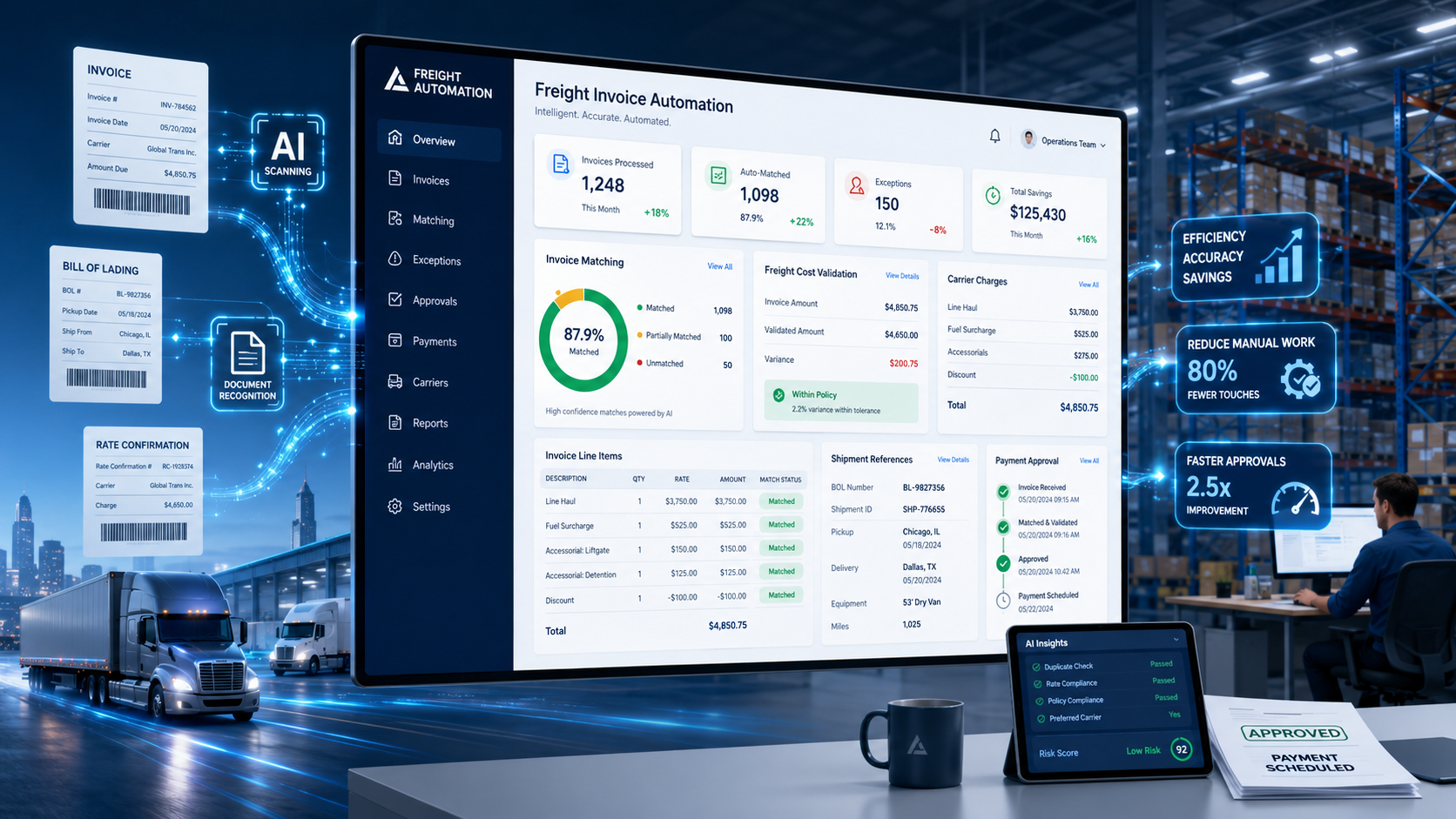
In this post, we'll explore five key ways technology can automate your freight invoicing, helping you save time, reduce errors, and improve your bottom line. From AI-powered data extraction to seamless integration with existing systems, let's dive into the world of automated freight billing and discover how these tools can simplify your invoicing workflow.
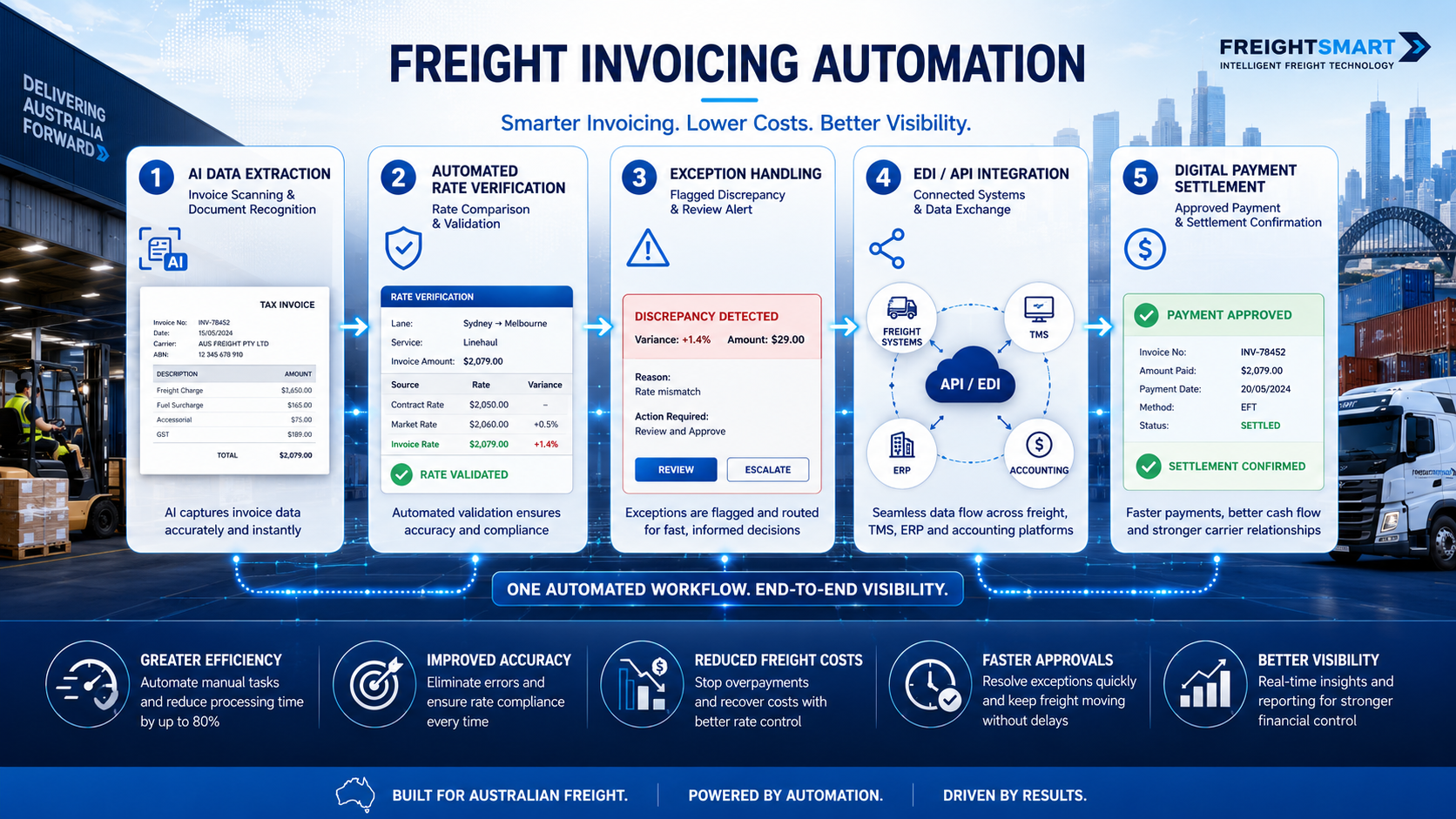
1. AI-Powered Data Extraction For Enhanced Freight Billing Accuracy
When I first started in the logistics industry, managing freight invoices was like navigating a maze. The paper trail, mixed with emails and PDFs, made it difficult to extract the right data without a lot of manual intervention. There were always discrepancies—sometimes small, other times enough to make you break into a cold sweat when it came time for audits. It wasn’t uncommon to spend hours verifying individual details, only to find a missing discount or a mismatch in rates.
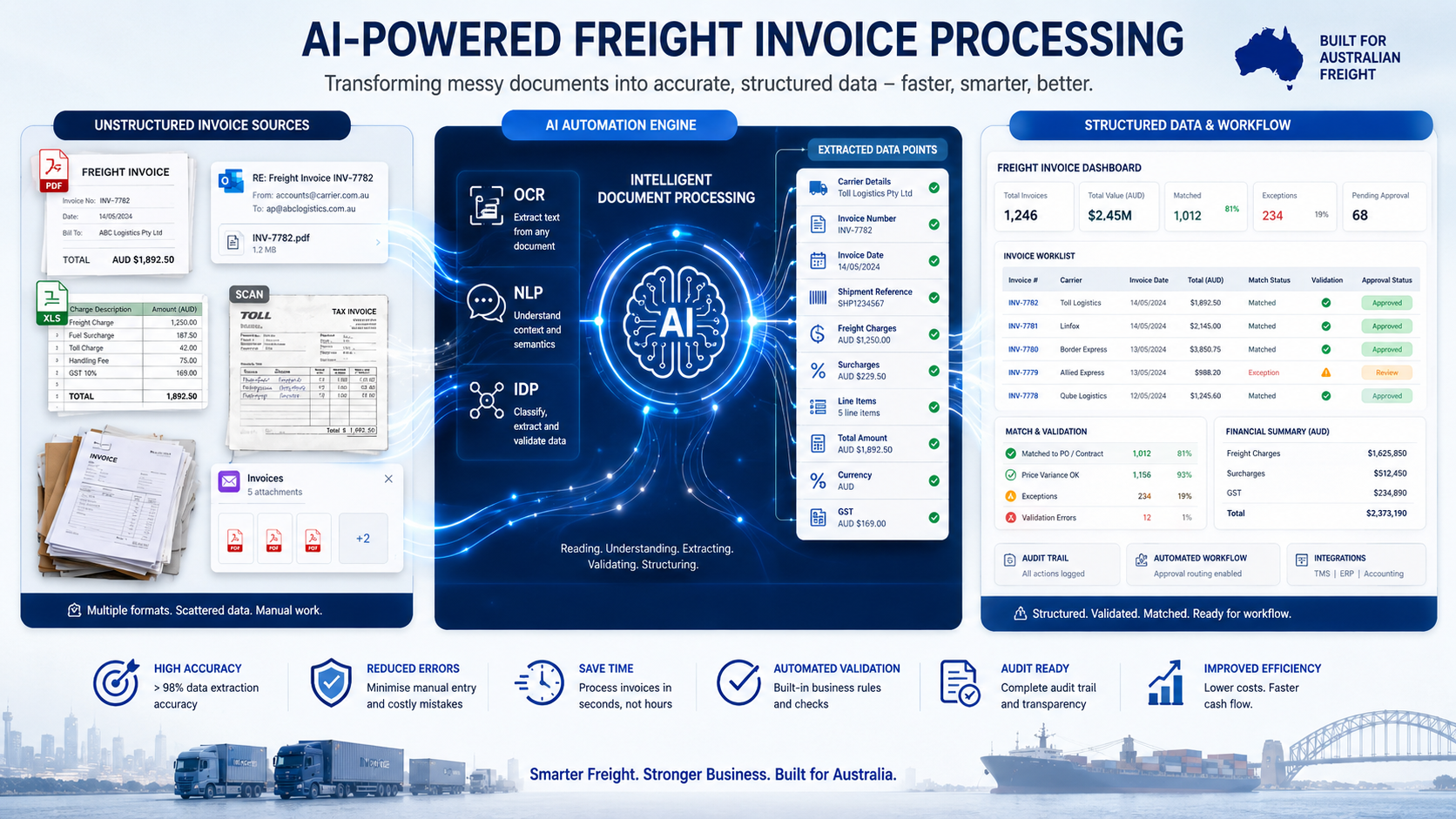
But technology has come a long way since then, especially with the introduction of Artificial Intelligence (AI) tools like Intelligent Document Processing (IDP) and Optical Character Recognition (OCR). These tools are game-changers. Instead of manually entering data from various sources (email attachments, spreadsheets, or even PDFs), AI-powered systems now extract the relevant information with remarkable speed and accuracy, reducing human error by as much as 98%. This is no small feat when you consider that freight invoices can include hundreds of line items across multiple carriers.
For example, imagine you're dealing with a shipment from Sydney to Melbourne. You receive an invoice for a load of machinery, but it’s all buried in unstructured formats—PDFs, email attachments, and scanned documents. Without AI tools, you'd be spending hours deciphering each invoice. However, with IDP, the system scans the documents, extracts the freight details—like shipment terms, rates, and charges—and transforms them into usable, structured data that your system can automatically process.
Take it a step further with Natural Language Processing (NLP), which enables the system to understand the context of the text. For instance, it could recognise that "THC" refers to "Terminal Handling Charges" and "Handling Charges," even if different carriers use slightly different terminology. This means the system can automatically standardise the data, ensuring that every invoice—no matter the source—follows the same format.
2. Rule-Based And AI-Powered Rate Verification: Revolutionising Freight Auditing
When it comes to freight invoicing, one of the most time-consuming tasks is ensuring that the rates applied to each shipment match the agreed-upon terms in contracts. For years, this meant going through thousands of pages of contracts, manually cross-checking rates, surcharges, and accessorial charges against the invoice. It's a process that’s not only prone to human error but also one that can easily lead to missed opportunities for cost-saving.
I remember a time when a client asked us to audit their freight invoices for discrepancies. After manually reviewing thousands of line items, we found overcharges on nearly 20% of the invoices. To put it simply, we were hemorrhaging money, and not even realising it! That’s when we decided to integrate automated auditing tools into our process.
The beauty of today’s automated auditing systems lies in their ability to match invoice charges against pre-approved rates, contracts, and shipment tenders with incredible speed and accuracy. Let’s take a look at how this works:
Step | How It Works | Benefits |
Digital Contract Management | AI systems maintain digital copies of all contract terms, including rate structures, fuel surcharges, and accessorial fees. | Ensures all terms are up-to-date and readily accessible for auditing. |
Automated Matching Rules | Pre-configured business rules automatically validate rates by matching invoices against the digital contract, shipment tenders, and supporting documents (e.g., Bill of Lading). | Reduces time spent on manual rate verification, ensuring compliance and preventing overcharging. |
Discrepancy Detection | The system flags errors like duplicate charges, missing discounts, and incorrect classifications (e.g., residential surcharges). | Reduces the risk of paying for services not rendered and helps recover overcharges. |
Intelligent Validation | AI tools analyse billing patterns, spotting systematic errors or even opportunities for rate optimisation, beyond simple contract comparisons. | Identifies long-term inefficiencies and cost-saving opportunities, often recovering 2-8% of total freight spend. |
This process is powered by AI algorithms that go beyond simple rule-based checks. Advanced systems use machine learning to "learn" from past invoices, identifying recurring issues and improving accuracy with every audit cycle. The result? Automated auditing that catches discrepancies in real-time, preventing costly errors and offering an ongoing path to cost optimisation.
For example, suppose a freight invoice contains a surcharge that wasn’t agreed upon in the contract. In that case, the system will not only highlight this discrepancy but also propose an optimal course of action—whether it’s to flag the charge for manual review or to automatically dispute it with the carrier. This approach can save businesses up to 8% on freight costs, and in some cases, even more.
3. Implementing Intelligent Automation For Workflow And Exception Handling
Imagine having a system in place that handles all the tedious exceptions in the invoicing process, freeing up your team to focus on high-value tasks. Well, thanks to technologies like Robotic Process Automation (RPA) and Intelligent Exception Management, that vision is now a reality for many freight and logistics businesses.
In the past, when an invoice didn’t match expectations (perhaps due to a slight rate change or a billing error), it would sit in a queue, waiting for someone to manually investigate and resolve the issue. This delayed the payment process, leaving room for bottlenecks and costly delays. I remember a time when this happened constantly—until we introduced RPA into our workflow.
Here’s how it works:
RPA bots handle repetitive tasks such as validating volume discounts, checking for duplicate charges, and even moving data between systems (TMS, ERP, etc.).
Automated Approval Workflows ensure that discrepancies within acceptable limits (e.g., a small difference in rates) are automatically approved, eliminating unnecessary delays.
Intelligent Exception Management automatically flags invoices that fall outside pre-set thresholds and performs root-cause analysis, identifying the issue and suggesting a resolution.
By implementing these intelligent systems, we saw a dramatic reduction in the time it took to clear discrepancies. What used to take days to resolve now takes mere hours, which means faster payments and stronger relationships with carriers.
4. Leveraging EDI And API Integration For Seamless Data Exchange
When it comes to automating freight invoicing, one of the most important steps is ensuring that data flows smoothly between your freight system, TMS, and ERP systems. In the past, this meant manually entering data from invoices into your financial software, leading to inevitable errors and delays. But with modern Electronic Data Interchange (EDI) and API integration, this is now a thing of the past.
One of the first things I noticed when we introduced EDI into our freight billing process was the speed at which we could process invoices. Instead of waiting for paper invoices to arrive or dealing with slow email attachments, we received invoices directly through EDI 210, a standard for freight invoices. These digital documents were automatically imported into our accounting system, reducing processing time from days to just hours.
Key Integration Benefits:
EDI: EDI automates the exchange of key documents such as freight bills, purchase orders, and shipment confirmations, replacing manual paperwork and reducing human error.
API Functionality: APIs allow for seamless communication between different platforms, from your TMS to your freight payment solutions, without any need for manual data entry. This real-time data transfer reduces processing time and ensures accuracy across all systems.
Data Normalisation: Whether you’re working with multiple carriers or different formats, data normalisation ensures that information is standardised across the board. For example, the same shipment charge might be described differently by various carriers—NLP can help to standardise these discrepancies, ensuring that each invoice is processed in the same format.
Integration Method | How It Works | Benefits |
EDI (Electronic Data Interchange) | Enables computer-to-computer exchange of business documents like invoices, shipment details, and purchase orders | Reduces errors, speeds up processing, and eliminates paper-based transactions |
API (Application Programming Interface) | Provides automated data exchange between TMS, ERP, and payment systems for real-time updates | Ensures seamless integration across platforms, improving efficiency and accuracy |
Data Normalisation | Standardises data from various carriers and document types into a uniform format for processing | Ensures consistency in freight charge reconciliation and reduces errors |
The real beauty of using EDI and APIs together is the speed and accuracy they offer. Instead of dealing with various forms and formats, the integration automates the data flow, cutting down on human intervention. In practical terms, this translates to quicker invoice approvals and faster payments, which in turn improve your cash flow and strengthen your relationships with your carriers.
For example, one of our clients, a large logistics provider, noticed an immediate improvement in invoice processing times after implementing EDI. Previously, it took up to two weeks to get invoices approved and paid, but after automation, this was reduced to just a few days. The time saved in processing, not to mention the reduced error rates, made a noticeable difference in their bottom line.
5. Digitising Payment And Settlement: Finalising Freight Invoices Efficiently
Once the freight invoice has been verified, the next critical step is the payment and settlement process. In traditional workflows, this stage can be plagued by delays—especially when invoices are tied up in approval chains or when there are discrepancies in the final amounts. However, with automated payment systems, this process becomes much more efficient, ensuring that payments are timely, accurate, and secure.
I’ve seen firsthand how automated accruals and AP generation can make the final step in the freight invoicing cycle smoother. By automating the creation of accruals based on shipment data, companies can track expenses as goods are shipped and ensure that funds are allocated correctly when the invoice arrives. This allows for more accurate forecasting and cash flow management.
Step | How It Works | Benefits |
Automated Accruals & AP Generation | At the time of shipment, the system generates cost accruals based on expected charges, which are automatically updated once the invoice is verified | Enables accurate liability tracking and smooth payment processing |
Digital Payment Systems | Automated systems support payment methods like card payments, PayPal, or specific freight payment solutions like ODeX | Ensures timely, secure transactions with minimal human intervention |
Real-Time Financial Visibility | Dashboards provide up-to-date data on payment statuses, revenue per route, and cash flow, allowing businesses to monitor financial health | Reduces payment disputes and enhances financial decision-making |
For example, using real-time payment systems, we were able to settle invoices instantly upon verification, significantly improving payment cycle times. Instead of waiting for the approval process to go through several layers of management, payments were made as soon as an invoice matched the agreed terms. Not only did this reduce the time between invoicing and settlement, but it also improved relationships with our carriers, who appreciated the faster turnaround times.
Additionally, platforms that provide real-time visibility into financial data offer logistics managers the ability to track and forecast their cash flow, ensuring that funds are available for future freight operations. This kind of visibility is crucial for any business, but especially in logistics, where cash flow management can make or break profitability.
To wrap up, automating freight invoicing isn’t just a nice-to-have—it’s an essential strategy for businesses looking to streamline operations, reduce errors, and save on freight costs. From AI-powered data extraction and automated rate verification to seamless integrations with digital payment systems, technology has proven to be a valuable ally in the invoicing process.
By embracing these automation tools, you’ll find that freight invoicing accuracy improves, cost savings increase, and invoice dispute resolution becomes a much less daunting task.
Let's Get Straight To The Point
Technology is revolutionising freight invoicing by automating processes that were once time-consuming and error-prone. From AI-powered data extraction and automated rate verification to EDI and API integrations, businesses can streamline their invoicing workflow, reducing errors and saving on costs. Robotic Process Automation (RPA) and intelligent exception handling further speed up approvals and issue resolution. Additionally, digital payment systems ensure timely, accurate settlements, improving cash flow. Automating freight invoicing leads to better accuracy, faster payments, and overall cost savings, transforming invoicing from a headache into a strategic advantage.
Frequently Asked Questions
What Are The Main Benefits Of Using Freight Invoicing Software?
Freight invoicing software improves accuracy, speeds up the invoicing process, and reduces human error, leading to significant cost savings.
How Can Automated Freight Billing Help With Invoice Disputes?
Automation helps catch discrepancies in real-time, allowing for quicker identification of overcharges or incorrect rates, reducing the chance of disputes.
What Is The Role Of EDI In Freight Invoicing?
EDI automates the exchange of key documents, such as invoices and shipment details, directly into your accounting systems, reducing the need for manual data entry.
How Does AI Improve Freight Billing Accuracy?
AI tools like OCR and NLP extract data from invoices with high accuracy, standardising the information and reducing human errors.
Can Automated Invoicing Reduce Freight Costs?
Yes, by ensuring accurate billing and catching discrepancies early, automated invoicing can reveal cost-saving opportunities, often recovering 2-8% of freight spend.