
Bring Your Own Rates: How Cario Gives Businesses More Control Over Freight Pricing
04 May 2026

Freight costs can be one of the most unpredictable parts of running a supply chain.
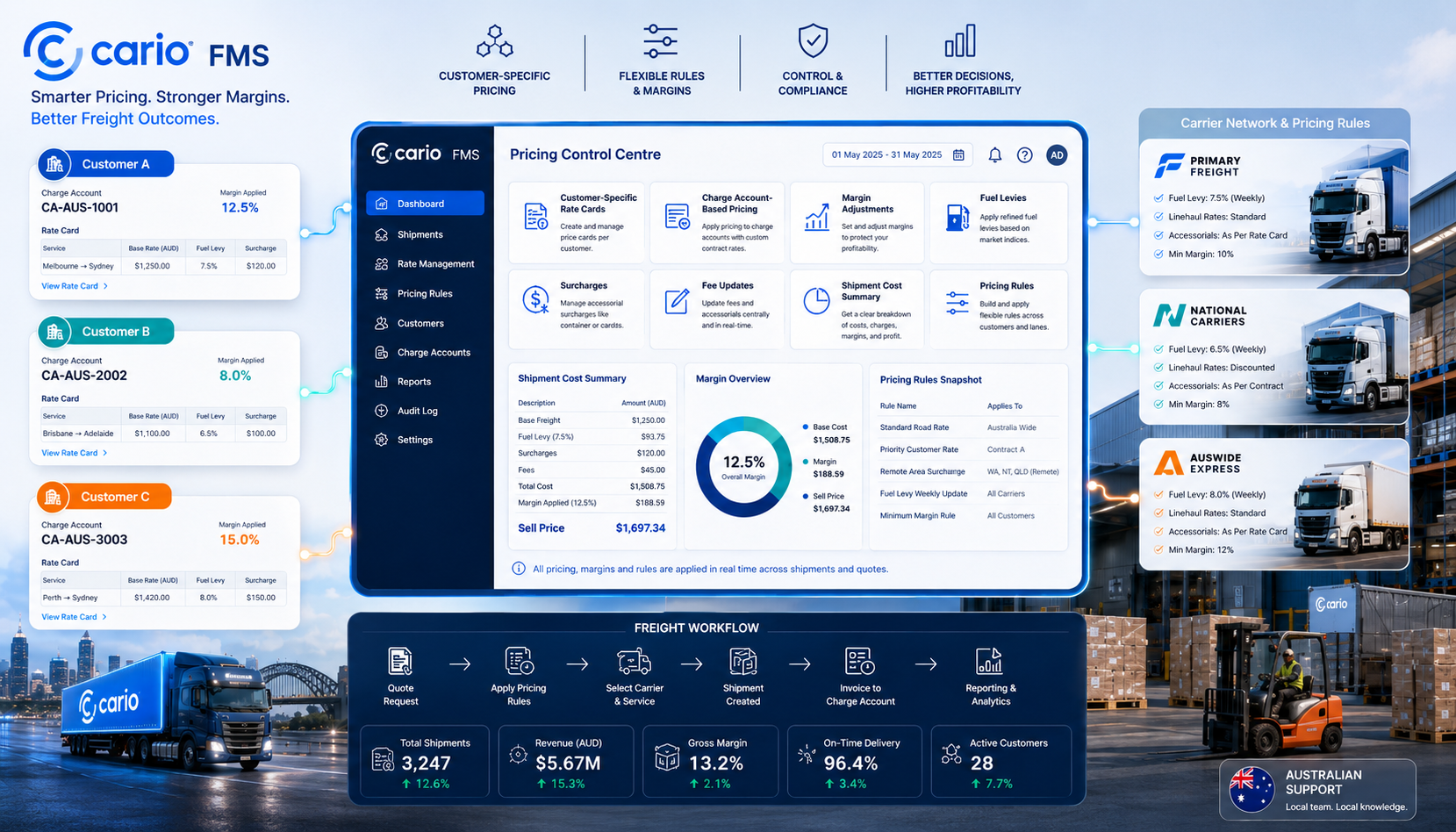
Rates change, surcharges move, carriers update their pricing structures, and different customers or business units may need to be charged differently depending on their agreements.
For many businesses, this creates a major challenge: how do you keep freight pricing accurate, transparent, and flexible without relying on spreadsheets, manual calculations, or disconnected systems?
This is where Cario Freight Management System (FMS) helps.
Cario allows businesses to manage freight rates in a way that suits their operation. Whether you want to connect directly to carrier live rates via API, upload your own negotiated rate cards, apply margins, update fees, or manage different rate cards by customer and charge account, Cario provides the tools to bring freight pricing under control.
Let’s Get Straight to the Point
Cario FMS allows businesses to bring their own freight rates into the platform through live carrier API rating or manual rate card uploads. Businesses can configure customer-specific rate cards, apply margins, update fees and surcharges, and manage different pricing based on charge account numbers. This gives teams greater control over freight costs, improves quoting accuracy, supports customer billing, and reduces reliance on manual spreadsheets.
What Does “Bring Your Own Rates” Mean?
“Bring your own rates” means businesses are not locked into one fixed pricing model or one carrier rating method.
Instead, Cario gives you the flexibility to use the freight rates that are relevant to your business, your carrier agreements, and your customer requirements.
This can include:
- Live carrier rates returned directly through an API connection
- Manually uploaded carrier rate cards
- Customer-specific rate cards
- Charge account-based rating
- Margin application
- Fee and surcharge updates
- Multiple carrier and service options for comparison
The goal is simple: give businesses more control over how freight is rated, quoted, booked, and reviewed.
Direct Live Rates from Carriers via API
For carriers that support API rating, Cario can connect directly to the carrier and retrieve live freight rates during the quoting or consignment creation process.
This means users can access carrier pricing in real time without needing to manually check external portals or calculate rates separately.
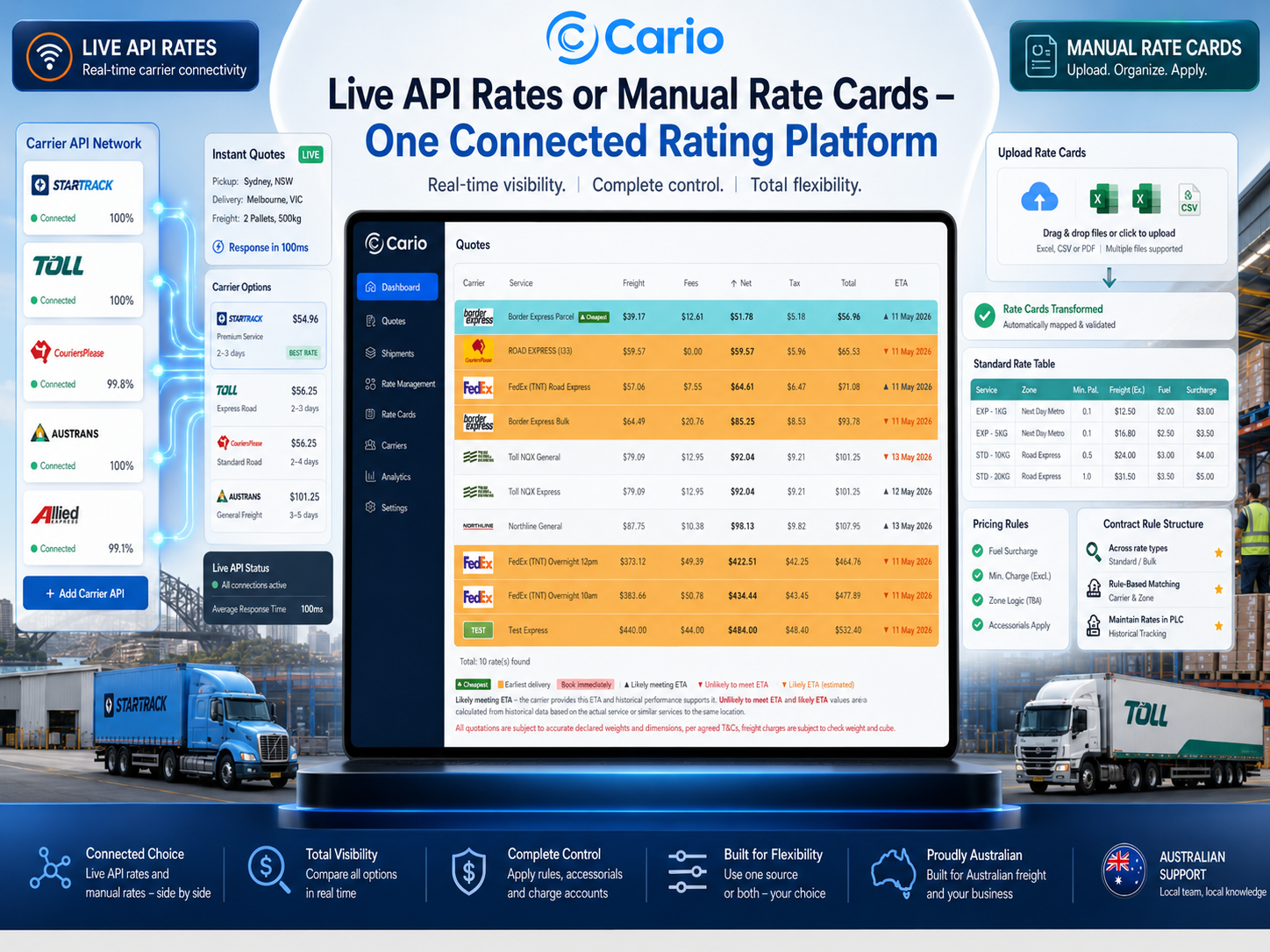
With live carrier API rates, businesses can benefit from:
- Real-time pricing from connected carriers
- Faster quoting and booking decisions
- Reduced manual handling
- Improved pricing accuracy
- Visibility across multiple freight options
- More confidence that the rate reflects the carrier’s current pricing logic
This is especially useful for businesses working with carriers where rates may depend on dynamic factors such as service type, pickup and delivery locations, weight, cubic volume, freight profile, and account-specific rules.
Instead of switching between systems, users can compare available freight options directly within Cario and select the most suitable carrier and service for the job.
Manual Rate Card Uploads
Not every freight operation relies on live API rates. Many businesses have negotiated freight rates with carriers that are provided in rate card format.
Cario supports this by allowing rate cards to be uploaded and configured within the platform.
Manual rate card uploads are useful when:
- A carrier does not provide live API rating
- Your business has negotiated fixed rates
- You need to manage specific pricing by zone, service, weight break, or cubic calculation
- You want to maintain internal control over how rates are applied
- You need a consistent pricing structure for quoting and reporting
By storing rate cards inside Cario, businesses can move away from offline spreadsheets and manual calculations. The rates can be used during consignment creation, quoting, and freight review, helping teams make better decisions with pricing information available upfront.
Managing Rates with Margins
For freight brokers, 3PLs, distributors, and businesses that on-charge freight to customers, margin management is critical.
Cario allows businesses to configure rates with margins so freight charges can be presented or applied according to commercial requirements.
This can help businesses:
- Protect margin on freight services
- Apply customer-specific pricing structures
- Support internal or external freight billing models
- Maintain consistency in how freight is charged
- Reduce the risk of manual pricing errors
For example, a business may receive a carrier base rate and then apply a margin before charging the customer. Instead of calculating this manually, Cario can help manage this logic through configured rate structures.
This gives teams better control over profitability and ensures freight charges are applied consistently across the business.
Updating Fees, Charges, and Surcharges
Freight pricing is not just about the base transport rate.
There may also be additional fees and charges such as:
- Fuel levies
- Manual handling fees
- Tail lift charges
- Residential delivery fees
- Oversize fees
- Dangerous goods fees
- Remote area charges
- Other carrier-specific surcharges
Cario allows businesses to manage and update freight-related fees so pricing can stay aligned with carrier changes and internal requirements.
This is important because freight charges can change regularly. If these updates are managed manually, there is a higher chance of outdated pricing, missed surcharges, and invoice discrepancies.
By keeping fees and charges maintained within the FMS, businesses can improve pricing accuracy and reduce the amount of manual checking required during freight reconciliation.
Different Customers, Different Rate Cards
Many businesses do not use one single freight pricing structure for everyone.
Different customers may have different rates depending on their contract, location, business unit, carrier agreement, or charge account number.
Cario supports this by allowing rate configuration to be aligned to different customers and charge accounts.
This means one customer may use one carrier rate card, while another customer may use a different rate card for the same carrier based on their assigned charge account number.
For example:
| Scenario | How Cario Supports It |
|---|---|
| Customer A uses Carrier X under Charge Account 1001 | Cario can apply the rate card linked to that charge account |
| Customer B uses Carrier X under Charge Account 2002 | Cario can apply a different rate card for that customer/account |
| A business unit has negotiated its own carrier pricing | Cario can separate rate logic by customer or account setup |
| A broker needs to apply customer-specific pricing | Cario can support different rate cards and margin structures |
This flexibility is especially valuable for businesses managing multiple customers, brands, warehouses, dispatch sites, or carrier accounts.
Rather than forcing everyone into one pricing model, Cario allows the freight rating setup to reflect the way the business actually operates.
Comparing Freight Options in One Place
One of the key advantages of managing rates inside Cario is visibility.
Instead of users needing to check multiple carrier portals, spreadsheets, or email quotes, Cario can bring freight options into one place.
This helps teams compare:
- Carrier options
- Service types
- Estimated freight charges
- Delivery options
- Account-based pricing
- Customer-specific pricing
- Available rate structures
This makes it easier to select the most appropriate freight option based on cost, service level, and operational requirements.
For businesses handling high volumes of consignments, this can save time across warehouse, customer service, finance, and transport teams.
Supporting Freight Review and Cost Control
Accurate rate management also plays an important role after freight has been booked.
When rates are configured properly in Cario, businesses can gain better visibility into expected freight charges, quoted freight costs, and invoiced freight costs.
This supports stronger freight review and cost control by helping teams identify:
- Unexpected charge differences
- Incorrect carrier invoices
- Margin issues
- Missed fees or surcharges
- Customer billing discrepancies
- Rate card updates that may be required
For finance and operations teams, this can reduce the amount of time spent investigating freight costs manually.
It also helps create a clearer connection between what was quoted, what was booked, and what was later invoiced.
Why Flexible Rate Management Matters
Freight pricing is rarely simple.
A single business may need to manage multiple carriers, service levels, customer agreements, charge accounts, locations, fees, and margin rules. Without the right system, this quickly becomes difficult to control.
Flexible rate management helps businesses:
- Improve freight cost visibility
- Reduce manual pricing work
- Support customer-specific freight billing
- Manage negotiated carrier rates
- Compare carrier options more easily
- Reduce pricing errors
- Improve invoice reconciliation
- Make better freight decisions
Cario is designed to support this flexibility by giving businesses the ability to configure freight rating in a way that reflects their real-world freight operations.
Moving Beyond Spreadsheets
Many businesses still manage freight rates using spreadsheets, shared folders, emails, or manual calculations.
While this may work at a small scale, it becomes harder to manage as freight volume grows.
Common problems include:
- Outdated rate cards being used
- Different teams using different versions of a spreadsheet
- Manual errors in calculations
- Missed fee updates
- Poor visibility over customer-specific rates
- Difficulty comparing carrier options
- Time-consuming invoice checks
By bringing rate management into Cario, businesses can create a more structured and transparent process.
Instead of freight knowledge sitting in disconnected files, Cario helps centralise rating logic into the freight workflow itself.
Final Thoughts
Bringing your own rates into Cario gives your business greater control over freight pricing.
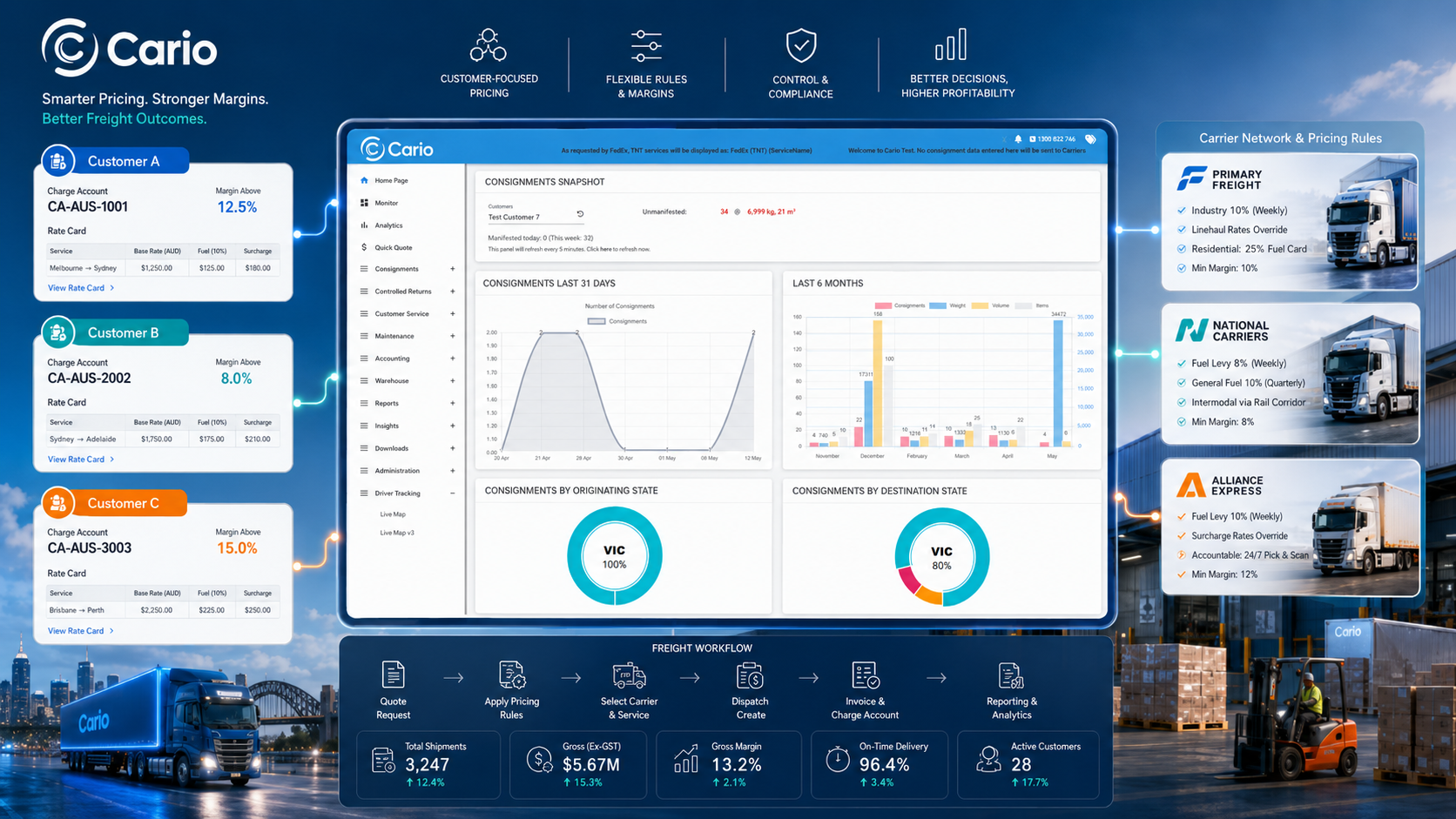
Whether you rely on live carrier API rates, uploaded manual rate cards, customer-specific pricing, margins, or charge account-based rate structures, Cario provides the flexibility to manage freight rates in a way that fits your operation.
For businesses looking to improve cost visibility, reduce manual work, and make smarter freight decisions, flexible rate configuration is an important step forward.
With Cario, freight rating becomes more than just a calculation. It becomes part of a connected freight management process that supports visibility, control, and better decision-making across the entire supply chain.
Frequently Asked Questions
Can Cario connect directly to carrier rates?
Yes. Where supported by the carrier, Cario can retrieve live freight rates through API connections, allowing users to access carrier pricing directly within the platform.
Can I upload my own carrier rate cards into Cario?
Yes. Cario supports manual rate card uploads, which is useful for negotiated carrier rates or carriers that do not provide live API rating.
Can I apply margins to freight rates?
Yes. Cario can support margin configuration so businesses can manage customer pricing, protect profitability, and apply consistent freight charges.
Can different customers use different rate cards?
Yes. Cario can support different rate cards for different customers, including rate logic based on charge account numbers.
Can fees and surcharges be updated in Cario?
Yes. Businesses can manage freight-related fees and charges, such as fuel levies, handling fees, and other carrier-specific surcharges, helping keep pricing accurate and up to date.