
6 Best Practices for Using Freight Contract Management Software in 2024
15 February 2024

Freight contract management is an area many businesses overlook until they're knee-deep in manual processes, discrepancies, or missed deadlines.

But in 2025, the tools and technologies available are transforming how freight contracts are managed. Freight Contract Management (FCM) software is more than just a digital filing cabinet—it's a strategic asset that can streamline operations, improve compliance, and save costs. In this post, we'll walk through six best practices for using FCM software, each one essential for staying ahead in today's fast-paced logistics landscape.
Whether working within an FMS platform like Cario or coordinating carrier agreements through freight brokers such as Freight People, logistics teams are increasingly treating freight contract management as a strategic capability rather than an administrative task.
1. Cloud-Secure Centralised Contract Repository
In the ever-evolving world of freight management, one constant that will never change is the need for security and accessibility. That's where a cloud-based, centralised contract repository comes into play. Think of it as your contract control tower—your go-to place for all contract-related data, right at your fingertips.
I’ve seen firsthand how centralising contracts in the cloud can revolutionise the way a business operates. A few years ago, we worked with a local logistics company that had contracts scattered across different departments and even stored in physical files. As you can imagine, retrieving the correct document was a time-consuming, stressful process, and mistakes happened more often than we'd like to admit. But once they made the switch to a secure, cloud-based repository, the transformation was immediate. Here’s why you need it:
Data Security And Access Control
One of the first things that comes to mind when we talk about contract management is security. Freight contracts contain sensitive data like rates, terms, and vendor agreements, which, if compromised, can cause chaos. A cloud-based repository ensures that all contract data is encrypted both "at rest" (stored) and "in transit" (sent externally). Plus, with role-based access control, you can ensure only authorised personnel can view, edit, or approve certain contracts.
Visibility And Quick Retrieval
The beauty of cloud storage is that it allows for real-time access. No more waiting for someone in another department to find a contract or scrambling to locate a document that's been misfiled. Whether you’re at the office or working remotely from a café in Melbourne, you can pull up contracts from any device with a secure login. It eliminates the time wasted digging through folders and ensures that critical information is available when you need it.
For example, a local freight forwarder in Sydney used to spend an hour or more every week retrieving and cross-checking contracts from different departments. Now, with everything in one place, they can find what they need in minutes. It’s a game-changer for productivity and accuracy.
Checkpoints For Success:
Ensure encrypted data storage both at rest and in transit.
Implement role-based access to control who can view or edit contracts.
Make sure the repository is accessible across devices, ensuring visibility at all times.
By centralising all your contract data in a cloud-based system, you’ll not only streamline your workflow but also drastically reduce the risk of errors and breaches, making it one of the first steps toward optimising your freight contract management.
2. Leverage AI And Automation For Operational Efficiency
When it comes to optimising freight contract management, automation isn’t just a luxury—it's a necessity. Freight contracts involve a multitude of repetitive tasks, from data entry to contract approvals, that are ripe for automation. The integration of AI and automation within contract management software can drastically reduce the time spent on these manual tasks, allowing your team to focus on more strategic, high-value work.
I remember working with an Australian logistics company that was drowning in the sheer volume of manual contract creation and approvals. Every time a new contract was needed, they would manually input data, cross-check pricing, and send documents back and forth for approvals. This process not only consumed a lot of time but was also prone to human error. After implementing AI-driven contract lifecycle management (CLM), the changes were remarkable. Here's how automation can help:
Data Extraction And Entry
AI-powered contract management tools are designed to handle the heavy lifting of data extraction. Instead of manually entering key terms, contract dates, pricing details, or performance metrics, the system can automatically pull these from the document and enter them into the correct fields. For example, when a new contract is uploaded, the AI scans it, extracts the necessary information, and populates your system, reducing human errors and speeding up the process.
Imagine this scenario: you’re about to sign a new contract with a freight supplier, and the system pulls the agreed rates, terms, and conditions from the document, auto-filling them into your system. You only need to double-check for accuracy—saving you hours, if not days, of manual entry.
Workflow Automation
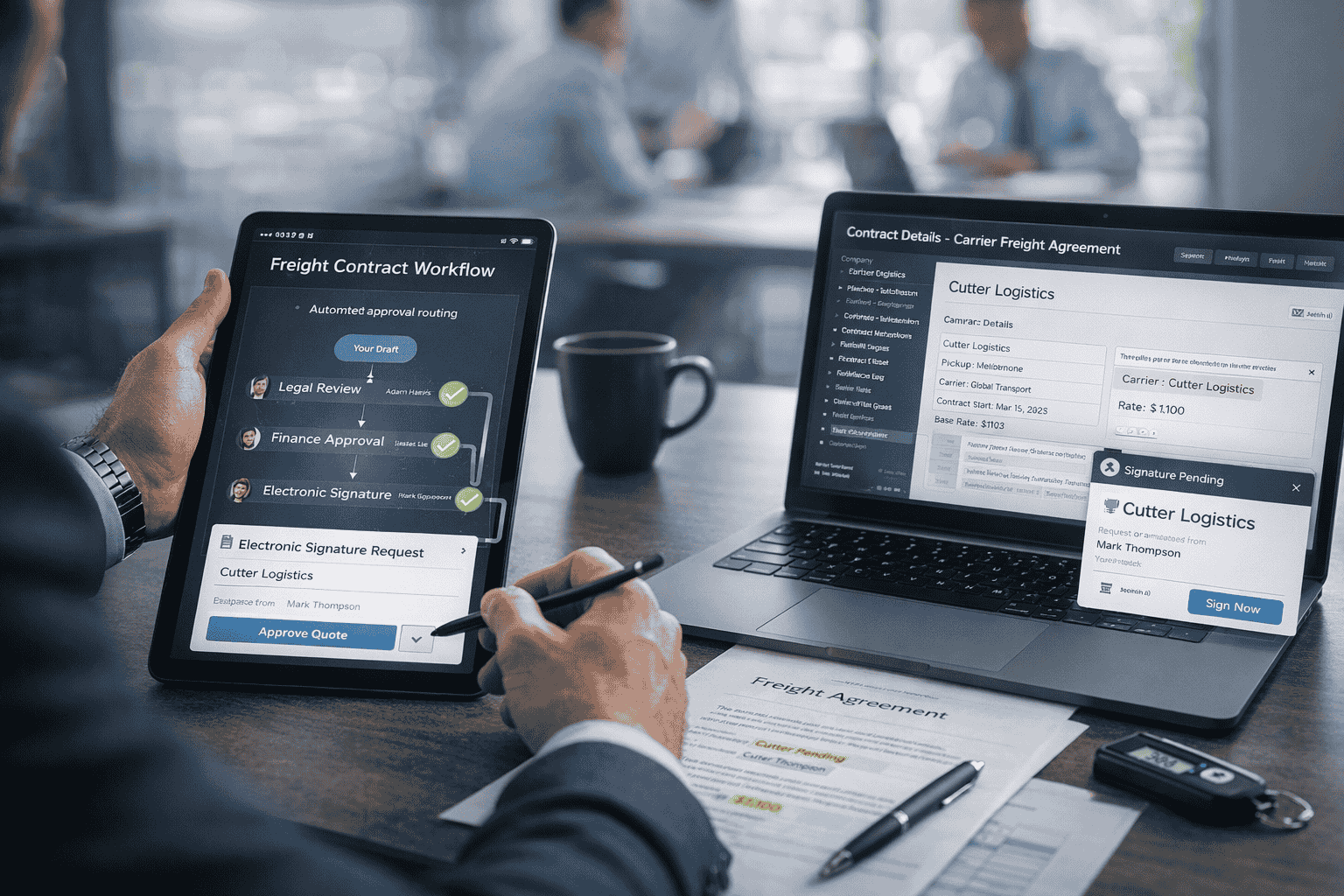
Freight contract management software can also automate entire workflows, including drafting, reviewing, and approval processes. Once a contract is drafted, it’s routed automatically to the appropriate stakeholders, reducing delays and bottlenecks. For instance, a contract for a new shipping route is drafted, then automatically sent to the legal team for review, followed by the finance team for rate validation, before being passed to the procurement manager for final approval.
The result? Contracts are finalised far faster. In one case, a shipping company was able to cut down its contract negotiation cycle by 80% after adopting workflow automation. Instead of having a drawn-out back-and-forth, the software handled the routing, approval, and signing processes, all in record time.
Electronic Signatures
One of the slowest parts of the contract lifecycle is the signature process. Traditionally, this requires multiple back-and-forth emails and waiting for physical signatures. By integrating electronic signatures (such as DocuSign or Adobe Sign), this process becomes instantaneous. Contracts can be signed in minutes, regardless of the location of the parties involved.
A freight company I worked with in Brisbane was using traditional signing methods, and it would often take weeks to get a contract signed, especially when dealing with multiple suppliers. With electronic signatures, they’ve sped up the process significantly, closing deals much quicker and ensuring they don’t lose out on timely opportunities.
Checkpoints For Success:
Automate data extraction from contracts to reduce manual entry errors.
Use workflow automation for drafting, approvals, and routing.
Integrate electronic signatures to accelerate contract execution.
By embracing AI and automation, you’ll see operational efficiency soar, leading to faster contracts, fewer errors, and a more streamlined freight management process overall.
3. Integrate Seamlessly With Existing Enterprise Systems
You wouldn’t run a freight operation without a Transportation Management System (TMS) or an Enterprise Resource Planning (ERP) tool. So, why should your freight contract management software operate in isolation? One of the most powerful best practices is ensuring that your contract management software integrates smoothly with your other business-critical systems. This interconnectedness not only improves data accuracy but also streamlines operations across departments.
I recall a case with a logistics company in Melbourne that had siloed systems for freight contracts, TMS, and finance. Each time a new contract was signed, the team had to manually input contract data into both the contract management system and the TMS for shipment tracking. This led to a significant risk of errors, with the most common being discrepancies between the agreed contract rates and the rates input into the TMS.
Once they integrated their freight contract management system with their TMS and ERP systems, the benefits were immediate:
Enhanced Data Accuracy
With integration, data entered in one system is automatically updated across all platforms. This ensures that contract data in the TMS, ERP, or procurement system is always up-to-date, with no risk of discrepancies between systems. For example, when a contract is signed, it automatically updates the agreed-upon rates in the procurement system, ensuring that all stakeholders are working with the latest figures.
Streamlined Operations
By linking the contract data directly with TMS and ERP systems, you can create a more seamless flow of information. For instance, as soon as a new freight contract is executed, the software automatically updates the shipping routes, schedules, and carrier management systems, aligning contract terms with operational needs. The end result? Optimised routes, improved carrier management, and smoother operations from start to finish.
Financial Control
Integration with procurement and financial systems, like accounts payable, helps you directly link contract terms with actual spend. For example, when a contract specifies a discount for a specific shipping volume, the finance team can automatically track savings, ensuring compliance with contract terms and making sure that no off-contract spending occurs.
Checkpoints For Success:
Ensure real-time updates across platforms (TMS, ERP, procurement systems).
Create a seamless flow of information between freight contracts and other business-critical software.
Improve financial tracking by linking procurement and financial systems with contract data.
By integrating your contract management software with other enterprise systems, you’ll streamline operations, reduce errors, and gain tighter control over your finances.
4. Utilise Advanced Analytics And Reporting Tools
In the age of big data, simply managing contracts isn’t enough—you need to extract actionable insights from the data within them. The true power of Freight Contract Management (FCM) software comes to life when you harness its analytics and reporting tools. These tools can transform raw contract data into strategic insights, allowing you to make smarter, data-driven decisions that benefit the bottom line.
I’ve seen firsthand how analytics can change the game. Take the example of a freight company in Perth that used to manually track contract performance metrics. They struggled with delayed insights and had difficulty adjusting to fluctuating freight rates or subpar carrier performance. After integrating advanced analytics into their FCM system, they were able to track key performance indicators (KPIs) in real-time. Here’s how you can use analytics for maximum impact:
Performance Monitoring
Freight contract performance isn’t just about checking if terms are met—it’s about tracking KPIs that matter. Using real-time dashboards, you can monitor the performance of your contracts against Service Level Agreements (SLAs), delivery timelines, and other key metrics. For example, you could track how often carriers meet their delivery deadlines and whether contracted freight rates align with actual shipping costs.
In one case, a freight forwarder in Sydney realised that a significant portion of their carriers were consistently underperforming in terms of timely deliveries. With analytics, they were able to identify specific areas for improvement and began renegotiating contracts with better penalties for non-compliance. This not only improved carrier performance but also led to cost savings as late deliveries dropped significantly.
Cost And Rate Analysis
One of the most valuable uses of contract analytics is cost analysis. By continuously tracking shipping trends and comparing actual freight costs with contracted rates, you can optimise pricing and renegotiate contracts more effectively.
For instance, consider a freight company operating in Melbourne that tracks shipping costs across different routes. Using historical data and rate analysis tools, they were able to spot pricing inconsistencies and identify areas for renegotiation. This gave them the leverage to renegotiate terms with suppliers and carriers, securing better rates and improving profit margins.
Risk And Opportunity Forecasting
Predictive analytics is another area where FCM software shines. By leveraging forecasting tools, you can anticipate risks and opportunities before they arise. For example, you can predict potential delays based on past performance, or even forecast capacity requirements for peak seasons.
A company in Brisbane used predictive analytics to identify potential supply chain disruptions ahead of time, which allowed them to make proactive changes to contracts and avoid costly delays. They also used these insights to renegotiate terms, ensuring that their contracts accounted for potential risks, like natural disasters or peak shipping seasons.
Checkpoints For Success:
Track KPIs such as carrier performance, SLAs, and delivery timelines in real-time.
Continuously analyse rates to ensure competitive pricing and identify renegotiation opportunities.
Use predictive analytics to forecast risks and opportunities for better contract optimisation.
Advanced analytics doesn’t just inform decisions—it shapes them, empowering businesses to stay ahead of the curve and make proactive adjustments to their freight contracts.
5. Establish Robust Review And Compliance Oversight
Freight contracts are far more than just agreements between suppliers and service providers; they are living documents that require continuous oversight. As regulations evolve and new standards emerge, it’s critical that your contracts remain compliant and aligned with the latest laws, environmental standards, and business requirements. This is where robust compliance oversight and automated reviews become indispensable.
Take it from me—when I worked with an Australian logistics provider, they were constantly scrambling to keep up with compliance requirements. There was always a fear of missing important contract renewals, price adjustments, or shifts in regulations, especially in the face of environmental regulations around CO₂ emissions and international trade rules. With the help of automated compliance features in their Freight Contract Management software, this process became seamless. Here's how to establish an effective compliance oversight system:
Automated Tracking And Alerts
One of the first steps in maintaining compliance is setting up automated tracking for key dates like contract renewals, expirations, and important milestones (e.g., price adjustments or rate renegotiations). With automated alerts, you can ensure that contracts don’t auto-renew without review or that renegotiations happen before rates become outdated.
For example, a major freight provider in Adelaide used automated reminders to track contract expirations, ensuring that they had enough time to renegotiate terms before auto-renewals kicked in. This saved them from costly last-minute negotiations and ensured that they maintained favourable terms.
Regulatory Compliance Checks
Freight contracts often involve compliance with local and international regulations, ranging from customs requirements to environmental standards like CO₂ emissions caps. Freight contract management software can help ensure that your contracts are always up-to-date with these regulations, automatically scanning contracts for compliance issues.
A case in point: A logistics company in Melbourne had to adhere to increasingly stringent environmental regulations. Their FCM software integrated a feature that checked whether all contracts with suppliers and carriers met the new environmental standards, specifically the CO₂ emissions tracking requirements. This automated compliance check saved time and reduced the risk of fines or penalties for non-compliance.
Regular Audits And Optimisation
In addition to real-time compliance checks, it’s essential to conduct regular audits of your contracts to ensure that terms are still relevant, beneficial, and aligned with market conditions. Periodic audits also allow you to reconcile rates and check for discrepancies between actual shipping costs and contracted rates.
A transport company in Sydney conducts quarterly audits of its contracts to ensure that the terms reflect the latest market conditions and business objectives. These audits have helped them find significant savings opportunities by identifying underperforming contracts and adjusting terms that were no longer in line with their business needs.
Checkpoints For Success:
Set up automated tracking and alerts for key dates like renewals and expirations.
Implement automated compliance checks to ensure contracts are aligned with changing regulations and standards.
Conduct regular audits to review contract terms and ensure they’re optimised for current market conditions.
By integrating automated compliance oversight, you can ensure that your contracts remain aligned with evolving regulations while also protecting your business from potential risks.
6. Invest In Training, Adoption, And Continuous Improvement
As powerful as Freight Contract Management software can be, it’s only effective when your team knows how to use it to its full potential. A robust training and adoption strategy is essential for ensuring that your team fully understands the capabilities of the software and can leverage it to improve contract management processes.
A few years back, I helped a medium-sized freight company in Brisbane implement an FCM system. Initially, the software sat underused because the team lacked training and understanding of its full potential. However, after we invested in comprehensive training and onboarding programs, the team was able to integrate it fully into their daily operations. Here’s how you can ensure successful adoption and continuous improvement:
Comprehensive Training Programs
Providing tailored training for team members is key. Not everyone will use the system the same way—what’s important to your procurement team may differ from what’s important to the legal or finance teams. Ensure training is relevant to each department’s specific use case, covering the basics of contract management as well as advanced features like contract analytics or performance monitoring.
Foster A Culture Of Learning
One of the things I’ve learned from my experience is that technology adoption isn’t a one-time event; it’s an ongoing process. Encourage continuous learning and development, and create feedback loops where users can share their experiences and offer suggestions for improvement. This creates a culture of continuous optimisation, ensuring the system evolves alongside your business needs.
Review And Optimise Software Usage
Regularly reviewing how the software is being used ensures that it continues to meet your business needs. New features and updates are often released, so it’s important to integrate them into your workflow as they become available. Conducting periodic reviews allows you to identify opportunities to further optimise processes and stay ahead of the curve.

Checkpoints For Success:
Invest in role-specific training to ensure team members are equipped to use the software efficiently.
Create a culture of continuous learning with feedback loops and regular reviews.
Regularly optimise software usage by incorporating new features and updates into your workflow.
A well-trained team that continually optimises its use of Freight Contract Management software will not only increase operational efficiency but also unlock the full potential of the software to drive smarter decision-making.
By implementing these six best practices—centralised cloud storage, automation, system integration, analytics, compliance oversight, and ongoing training—you’ll unlock the true potential of your Freight Contract Management software in 2025. These practices help streamline operations, mitigate risks, and ultimately save time and costs, giving your business a competitive edge in the ever-evolving freight landscape.
Conclusion
To optimise freight contract management in 2025, follow these six best practices:
Cloud-Secure Centralised Repository: Store all contracts in a secure, cloud-based system for easy access and enhanced security.
AI and Automation: Automate data entry, workflows, and e-signatures to improve efficiency and reduce errors.
Seamless Integration: Integrate contract management software with other systems like TMS and ERP for accurate data flow and streamlined operations.
Advanced Analytics: Use contract data analytics to monitor performance, optimise rates, and forecast risks for better decision-making.
Review and Compliance Oversight: Set up automated tracking for renewals, compliance checks, and regular audits to ensure contracts remain aligned with regulations.
Training and Continuous Improvement: Invest in comprehensive training and create a feedback loop for ongoing software optimisation and team adoption.
By leveraging these practices, businesses can streamline their contract processes, save costs, and stay compliant with evolving industry standards.
Frequently Asked Questions
How Does Freight Contract Management Software Improve Operational Efficiency?
By automating manual tasks, integrating with other systems, and providing real-time insights, FCM software reduces errors and accelerates workflows.
What Are The Key Features To Look For In Freight Contract Management Software?
Features like cloud-based storage, AI-powered automation, seamless integration with TMS and ERP, and real-time contract tracking are essential for optimising contract management.
How Can Analytics Enhance Freight Contract Management?
Advanced analytics allow you to track performance metrics, forecast risks, and optimise pricing, leading to better decision-making and cost control.
What Are The Benefits Of Automating Contract Reviews And Compliance Checks?
Automation ensures contracts remain compliant with changing regulations, reduces the risk of missed deadlines, and ensures continuous oversight.
How Can I Ensure My Team Is Effectively Using Freight Contract Management Software?
Providing comprehensive training, fostering a culture of continuous learning, and regularly reviewing software usage are crucial for maximising the software’s potential.