
What You Need to Know About Automation In Logistics
29 November 2022

Australia’s freight and logistics sector has always been a tough game. Between long-haul routes that stretch from Melbourne to Darwin and unpredictable weather that can wash out entire transport corridors overnight, keeping goods moving efficiently isn’t for the faint-hearted. Over the past few years, I’ve seen one thing transform this industry faster than anything else — automation.
From robotic picking systems in Sydney’s western warehouses to AI-powered freight scheduling across the east–west corridor, automation is no longer a futuristic buzzword. It’s here, changing how we plan, move, and deliver goods every single day. Yet, many Australian operators still ask the same question: “Where do we even start?”
This article unpacks exactly that — what automation in logistics really means, how it’s reshaping the supply chain, and the smart technologies driving efficiency across the country. Let’s kick off with the basics.
Let's Get Straight To The Point
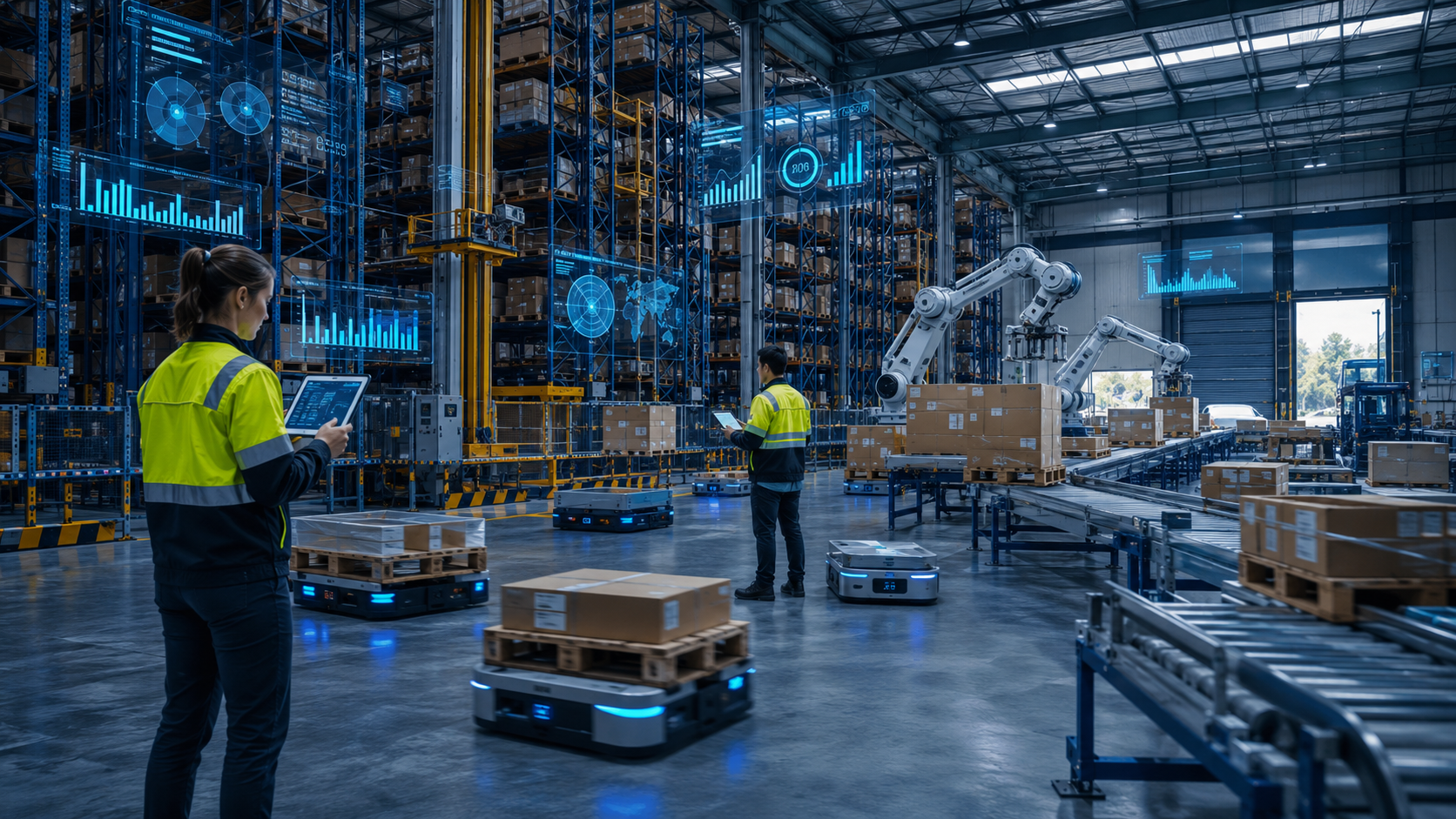
Automation in logistics uses robotics, software, and AI to boost efficiency, accuracy, and speed across supply chains. In Australia, it’s rapidly gaining traction due to labour shortages, rising transport costs, and customer demand for faster delivery.
Key technologies include warehouse systems (AS/RS, AMRs), transport automation (autonomous trucks, drones), and smart software (AI, IoT, RPA). Businesses see measurable benefits — up to 600% higher productivity, 50% lower operating costs, and near-perfect order accuracy.
However, challenges remain: high upfront investment, system integration hurdles, cybersecurity risks, and staff resistance. The future points to autonomous, data-driven logistics, where AI and predictive analytics guide every movement from factory to front door. Success depends on combining technology with skilled people, a clear strategy, and steady investment.
Understanding Automation In Logistics: From Manual To Machine-Led
When I first started in logistics more than two decades ago, everything was manual — paper consignment notes, phone calls to confirm delivery times, and warehouse pickers walking kilometres a day just to locate pallets. Fast forward to today, and you’ll find operations managed by software that can predict bottlenecks before they happen, with robots shifting goods faster than a forklift on overtime.
At its core, automation in logistics refers to the use of software, robotics, and smart systems to carry out repetitive or data-driven tasks — from order picking and packing to route optimisation and freight billing. It’s all about streamlining workflows, reducing human error, and boosting productivity.
But what makes it truly game-changing is how deeply it integrates physical and digital processes. Modern logistics automation connects everything — the trucks, warehouses, drivers, and even the data from IoT sensors tracking goods in transit. It’s a complete ecosystem where machines handle the grunt work while humans focus on strategy and problem-solving.
Here’s how I explain it to clients in plain terms:
Automation doesn’t replace people — it replaces inefficiency.
Key Drivers Of Automation Across Australia’s Supply Chain
Automation isn’t happening in isolation. A combination of economic pressure, labour shortages, and rising customer expectations drives it.
Labour Constraints: After COVID, the logistics industry faced one of its worst skill shortages on record. Many warehouse and transport roles went unfilled, particularly in regional areas. Automation has stepped in to fill the gaps — not by removing jobs, but by enabling smaller teams to do more with less.
Cost Pressures: Freight rates and fuel costs have surged over the past decade. Automated systems help reduce operational waste, cutting everything from empty miles to warehouse downtime.
Customer Expectations: Whether you’re shipping groceries from Brisbane or spare parts to Perth, customers now expect near-instant updates and two-day delivery — automation makes that possible.
Government Push for Digital Supply Chains: The Australian Government’s National Freight and Supply Chain Strategy encourages the adoption of smart logistics systems to improve visibility and resilience across domestic and international freight routes.
Example: Automation In Action – A Regional Warehouse Story
A mid-sized 3PL operator in regional Victoria recently made a simple but powerful upgrade — integrating automated storage and retrieval systems (AS/RS) with its existing warehouse management platform. Before automation, picking and packing orders for a large retail client could take up to 90 minutes. After implementation, that dropped to under 20.
The kicker? The same team handled 30% more orders without hiring extra staff. This isn’t science fiction — it’s what happens when technology and process meet smart planning.
Checklist: Signs Your Business Is Ready For Automation
Indicator | What It Means | Why It Matters |
Repetitive manual tasks | Staff spend hours re-entering data or locating stock | High-value time wasted on low-value work |
Error-prone operations | Frequent order or billing errors | Damaged customer trust and rising costs |
Rising labour costs | Overreliance on overtime or contractors | Automation can stabilise workforce costs |
Limited visibility | No real-time tracking or performance data | Hinders decision-making and accountability |
Space constraints | Warehouses near full capacity | AS/RS or smart layouts can improve space use by up to 40% |
If you recognise two or more of these signs, you’re probably at the point where automation could deliver quick wins.
Core Technologies Powering Logistics Automation

When you walk through a modern Australian distribution centre today, it’s a far cry from the warehouses I knew in the early 2000s. Back then, forklifts, pallet jacks, and clipboards ruled the floor. Now, you’ll see autonomous vehicles gliding down perfectly mapped aisles, robotic arms stacking cartons with surgical precision, and dashboards lighting up with real-time data from every corner of the facility.
The truth is, logistics automation isn’t one single technology — it’s a layered system where hardware and software work hand-in-hand to keep goods moving. Let’s break it down into the main categories driving the shift.
A. Warehouse And Intralogistics Automation
Intralogistics refers to the movement and coordination of goods inside a warehouse or distribution centre. This is where most businesses begin their automation journey because the ROI is often clearest.
1. Automated Storage And Retrieval Systems (AS/RS)
These are computer-controlled systems that handle goods storage and retrieval without manual input. They can operate around the clock, maximising space by stacking inventory right up to the ceiling.
In a Sydney FMCG warehouse I visited last year, an AS/RS installation increased throughput by 500% within six months — the same floor space, but vastly improved capacity.
2. Mobile Robots – AGVs and AMRs
Automated Guided Vehicles (AGVs) follow fixed paths using magnets or lasers. Autonomous Mobile Robots (AMRs), on the other hand, think for themselves. They use sensors and mapping data to move safely around obstacles, rerouting in real time when someone walks through their lane.
A Brisbane 3PL recently introduced AMRs for internal freight transfer, cutting pick times by 40% and eliminating unnecessary forklift travel.
3. Robotic Handling Systems
Robotic arms and pick-and-place machines are increasingly common in e-commerce fulfilment centres. They handle repetitive lifting, stacking, and palletising with accuracy that no human can match for long shifts.
For fragile or mixed goods, these robots can be equipped with AI-powered vision systems that identify products and handle them with the right grip strength.
4. Conveyor And Sortation Systems
These systems move cartons or parcels between storage, packing, and loading docks. They form the backbone of most automated facilities — keeping everything flowing smoothly. For regional facilities, modular conveyor designs are gaining traction because they’re easier to scale up or reconfigure when operations grow.
B. Transportation And Last-Mile Automation
While warehouses have led the charge, transport automation is catching up quickly — especially across Australia’s sprawling freight network.
1. Autonomous Trucking
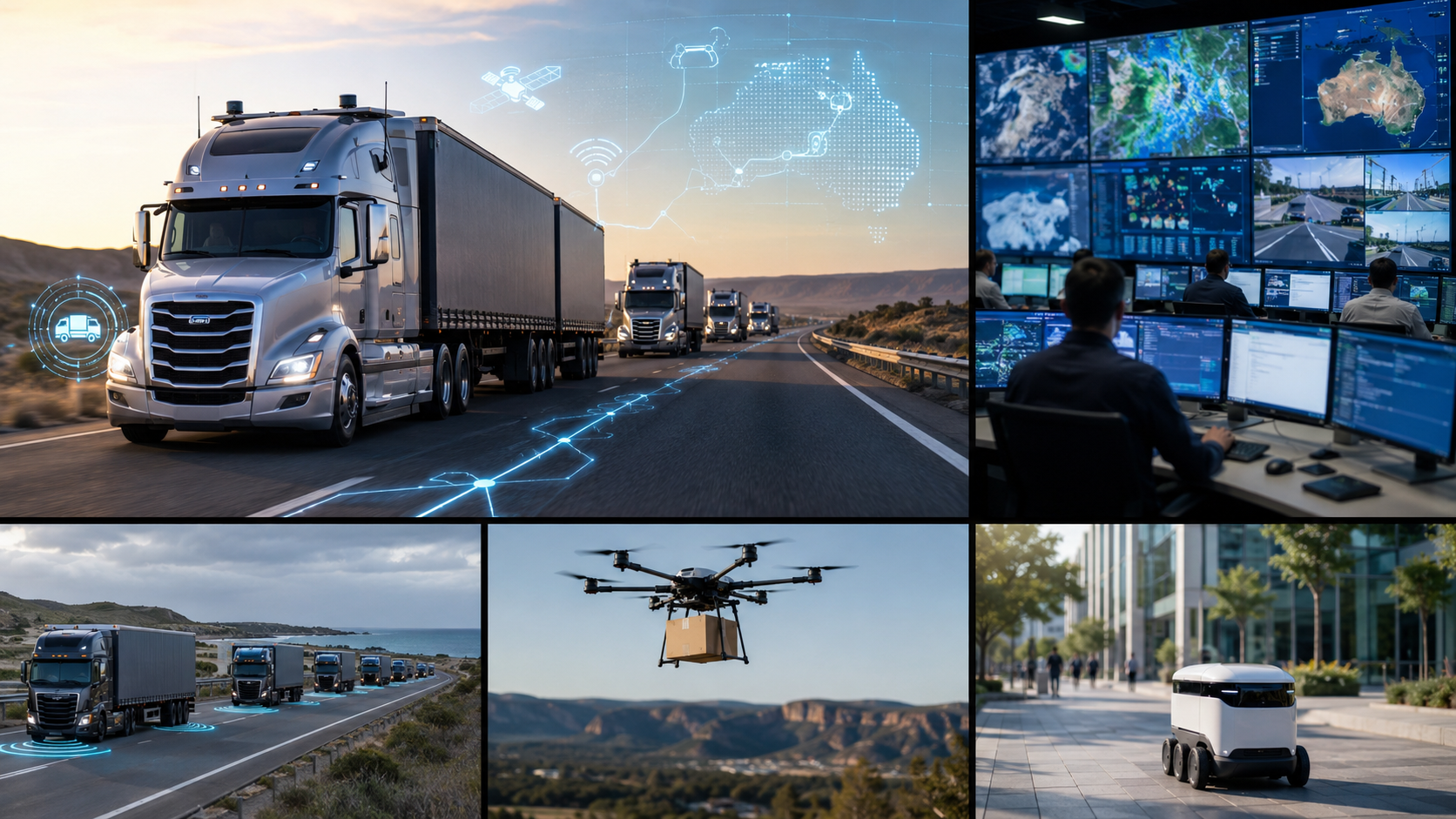
Imagine trucks that never need rest breaks, don’t get fatigued, and can operate through the night. Self-driving trucks are being tested globally and could soon become a reality on Australia’s highways.
Given the vast distances between key freight hubs — for instance, the 4,000km Sydney–Perth corridor — autonomous freight could slash delivery times and improve safety. Trials near Toowoomba and Wagga Wagga are already exploring how these systems perform in regional conditions.
2. Truck Platooning
This technology allows multiple trucks to travel in a convoy, maintaining a close distance through sensors and communication systems. The benefit? Dramatic fuel savings and reduced emissions thanks to aerodynamic efficiency.
With Australia’s rising diesel costs and carbon reduction targets, platooning could be a game-changer for linehaul operators.
3. Drones And Sidewalk Delivery Robots
For last-mile delivery, drones are now being trialled in suburban Queensland and the ACT. They can bypass traffic congestion, delivering parcels in minutes rather than hours. Meanwhile, ground-based robots are starting to handle micro-deliveries within business parks and university campuses — ideal for short, repetitive routes.
C. Software And Enabling Technologies
If the hardware is the muscle, software is the brain of logistics automation. It connects, coordinates, and optimises every moving part.
1. Warehouse Management And Execution Systems (WMS/WES)
These platforms control all warehouse operations — receiving, picking, packing, and dispatch. They integrate with automation equipment and ERP systems to synchronise orders, assign tasks, and monitor performance in real time.
In one Melbourne facility I worked with, the introduction of a smart WMS alone cut order errors by 70% before a single robot was added.
2. Artificial Intelligence (AI) And Machine Learning (ML)
AI tools drive predictive logistics — forecasting demand, managing routes, and identifying bottlenecks before they occur. Machine learning algorithms use historical and real-time data to keep improving accuracy.
For example, AI can predict delays caused by Sydney’s notorious Friday traffic or Perth’s peak-season congestion, then automatically reroute shipments to maintain delivery windows.
3. Robotic Process Automation (RPA)
RPA handles repetitive office work such as data entry, invoice matching, or freight claims. One large Australian freight forwarder I consulted automated its billing system using RPA and saved roughly 2,000 admin hours per month — time redirected to customer service.
4. Internet Of Things (IoT)
Sensors on pallets, trucks, and containers now feed continuous data about temperature, location, and vibration. This real-time visibility means supply chain managers can act the moment something goes wrong — whether it’s a cold-chain breach or an unexpected delay on the Hume Highway.
Summary Table: Automation Technologies And Their Impact
Category | Technology | Primary Benefit | Typical ROI Timeline |
Warehouse Automation | AS/RS, AMRs, robotic picking | Faster order fulfilment and better space use | 12–24 months |
Transport Automation | Autonomous trucks, platooning | Lower fuel costs, higher uptime | 2–4 years |
Software Automation | AI, RPA, WMS integration | Reduced admin load, improved accuracy | 6–18 months |
IoT & Data Systems | Sensors, digital twins | Real-time tracking and predictive maintenance | 12–36 months |
Automation technology isn’t about replacing people; it’s about restructuring work so that humans focus on what machines can’t — problem-solving, innovation, and customer relationships. As the saying goes, “Let the robots lift, and let people think.”
The Benefits And ROI Of Logistics Automation
I’ve yet to meet a logistics operator who invests in automation “just because it’s cool.” In our industry, every dollar must justify itself — and automation earns its keep. Over the past decade, I’ve seen automation deliver measurable gains across speed, cost, safety, and reliability. When done right, the payoff is enormous.
Let’s unpack what those benefits look like in real terms, and how businesses — from family-run warehouses in Altona to large-scale 3PLs in Brisbane — are seeing returns.
A. Efficiency And Speed: Doing More In Less Time
A well-designed automated system can make your operation run like clockwork. Machines don’t fatigue, don’t forget, and don’t need shift breaks.
I remember walking through a Perth warehouse that had just installed an Automated Storage and Retrieval System (AS/RS). Before automation, the team processed around 300 orders per shift. Three months later, that number jumped to 1,800 — a sixfold increase — with the same headcount.
This type of efficiency isn’t rare. With warehouse automation, productivity can rise by 400–600%, and order fulfilment times drop dramatically. That means your customers get goods faster, with fewer errors, and your team avoids burnout from relentless manual tasks.
Checklist: How To Measure Efficiency Gains
Metric | Pre-Automation | Target After 12 Months |
Average order fulfilment time | 2 hours | 30 minutes |
Picking accuracy | 94% | 99.9% |
Throughput per labour hour | 10 picks/hour | 50 picks/hour |
Average delivery time | 48 hours | Under 24 hours |
B. Cost Reduction: Turning Efficiency Into Profit
Automation is often viewed as expensive upfront, but the long-term math tells a different story. Once systems are operational, labour and error-related costs plummet.
In one freight business I advised in western Sydney, automated labelling and pallet sortation reduced overtime costs by 40% within six months. When the team later introduced robotic picking, they managed to reassign half their casual workforce to higher-value roles instead of letting them go.
Automated freight and transport systems also save on fuel and resource usage. AI-driven route optimisation can reduce freight costs by up to 30% through smarter scheduling and better truck utilisation.
Typical ROI Windows For Automation Projects
Type of Automation | ROI Period | Primary Savings Source |
Administrative (RPA, billing automation) | 6–12 months | Reduced labour hours |
Warehouse systems (AS/RS, conveyors, AMRs) | 12–24 months | Productivity and accuracy |
Transport automation (autonomous trucking, IoT monitoring) | 2–4 years | Fuel, compliance, downtime |
Predictive analytics (AI forecasting, digital twins) | 18–36 months | Inventory optimisation, fewer disruptions |
C. Accuracy And Quality: Reducing Costly Mistakes
In logistics, errors are expensive — a single mispick can cost anywhere from $25 to $100 once you factor in return handling and lost goodwill. Automation brings near-perfect precision, often reaching 99.9% fulfilment accuracy.
I recall a national retailer’s warehouse in Adelaide that moved from manual scanning to vision-based robotic picking. Their order errors dropped by 97% within weeks. Those “small” errors they used to write off? They added up to thousands per month.
Automation also tightens inventory control. With real-time tracking and smart sensors, warehouse managers can see exactly what’s in stock, what’s due, and what’s delayed. This reduces overstocking, dead inventory, and customer disputes.
D. Workforce And Safety Improvements
Let’s face it — warehouse work can be tough. Long shifts, repetitive motion, and heavy lifting make it one of the higher-risk sectors for injury.
When an operation introduces robotics or automated handling, the change is almost immediate: fewer injuries, less fatigue, and better morale. A national 3PL in Queensland reported a 35% drop in workplace incidents after automating pallet movements and hazardous lifting.
Automation also enhances job quality. Rather than replacing workers, it redefines roles. Employees shift from repetitive labour to monitoring, exception handling, and decision-making. One warehouse supervisor told me, “I used to chase pickers around the floor; now I manage data and process flow — and I’m finally home for dinner.”
E. Space, Scalability, And Sustainability
1. Smarter Space Use
In urban centres like Sydney or Melbourne, warehouse rent per square metre can break budgets. Automation offers a solution — by going vertical. AS/RS systems allow for denser storage, improving space use by up to 40%.
2. Scalability
Automated systems can flex to meet demand peaks — like the Christmas rush or Black Friday sales — without major staffing changes. One e-commerce distributor in South Australia used AI-driven forecasting to scale its workforce plan two weeks before a demand spike, avoiding the usual scramble for labour hire.
3. Sustainability
Fuel optimisation, electric AMRs, and AI route planning all contribute to lower carbon emissions. Autonomous fleets, for example, can cut emissions by 10–40% by eliminating idling and improving fuel efficiency. For Australian businesses under increasing pressure to meet sustainability targets, automation isn’t just efficient — it’s responsible.
F. Resilience And Business Continuity
The pandemic exposed just how fragile global supply chains can be. Businesses that already had automation in place — particularly digital visibility tools and AI forecasting — recovered 60% faster from disruptions than those relying purely on manual processes.
Automation gives you visibility and agility. When systems monitor every shipment, route, and machine in real time, you can pivot instantly — reroute a truck, flag a delay, or reassign warehouse resources.
As climate events, fuel volatility, and geopolitical pressures continue to shape logistics, this kind of adaptability is becoming the new standard.
Automation isn’t about chasing a technology trend — it’s about building a more efficient, safer, and future-ready logistics operation. As someone who’s seen both sides of the industry — the paper-and-pencil era and the AI-driven one — I can say this with confidence: once you experience a well-automated system, you’ll never want to go back.
Challenges And Barriers To Adopting Automation In Logistics
Every logistics manager I’ve worked with who’s considered automation hits the same realisation early on — it’s not plug-and-play. While the technology looks impressive on paper, rolling it out across an active warehouse or transport network takes patience, planning, and a fair bit of grit.
Let’s look at the most common hurdles that hold businesses back and how to manage them before they derail your investment.
A. Financial Barriers: The High Cost Of Entry
Automation delivers returns, but the initial investment can sting. Setting up robotics, control systems, and supporting infrastructure often costs millions. For small or mid-sized operators, that’s enough to put automation on the back burner.
In my experience, the trick is to start small — target one high-impact area first. For example, a Melbourne warehousing firm began with automated labelling and dispatch verification, spending under $250,000. Within a year, the savings funded a larger conveyor system upgrade.
A gradual, phased approach helps prove ROI before committing to a full rollout.
B. Technical And Integration Challenges
Older ERP and TMS systems can be stubborn when integrating with modern automation. I’ve seen businesses spend more on software integration than on hardware. Data silos between the warehouse, transport, and finance teams often cause delays and double-handling.
To prevent that, plan early for system interoperability. Choosing technology partners with open APIs and proven local support saves headaches later. Also, never overlook cybersecurity — IoT-connected devices expand your exposure to potential breaches. Regular audits and secure cloud hosting are now non-negotiables.
C. Workforce And Organisational Resistance
Automation’s biggest obstacle isn’t technology — it’s people.
Many employees worry that automation means redundancy. That fear is understandable, especially when you’ve got long-serving warehouse staff who’ve built careers around manual processes. I’ve seen smooth transitions when companies are upfront about their intentions and back it with retraining programs.
Instead of replacing staff, show them how automation improves their workday — fewer back injuries, smarter roles, and better work-life balance. As one warehouse manager in Newcastle told me after introducing AMRs, “Our people realised the robots don’t take jobs — they take the sore backs.”
D. Management Commitment And Vision
Automation demands leadership buy-in. Without it, projects stall midstream. I’ve seen warehouses full of half-installed equipment because no one championed the project after go-live.
The key is for management to stay engaged — track KPIs, celebrate wins, and communicate progress. When leadership treats automation as an ongoing strategy rather than a one-off purchase, the results compound over time.
E. Summary Table: Barriers And Smart Workarounds
Challenge | Impact | Practical Solution |
High capital cost | Limits early adoption | Start small; prove ROI before scaling |
Legacy systems | Data bottlenecks | Upgrade in phases; prioritise open API tech |
Cybersecurity risk | Threat to operations | Implement layered security and monitoring |
Workforce anxiety | Resistance and turnover | Retrain and communicate early |
Weak leadership buy-in | Implementation delays | Appoint a project champion and report KPIs |
Automation is a journey, not a one-time install. The best operators treat each upgrade as a building block — one that adds stability, accuracy, and intelligence to the supply chain.
Automation has already reshaped how freight and logistics operate in Australia — from the warehouses of Sydney to the remote trucking corridors of Western Australia. It’s no longer about whether automation will define logistics; it’s about how well you prepare for it.
The businesses that thrive aren’t necessarily the biggest — they’re the ones that invest wisely, start small, and build systems that learn, adapt, and grow. Automation isn’t about replacing people; it’s about creating smarter, safer, and more resilient operations that can weather any disruption, whether it’s a flood in Queensland or a global supply chain crunch.
As I often tell clients, automation won’t solve every problem, but it gives you the visibility and control to handle the ones that matter most. And that’s worth its weight in freight.
Frequently Asked Questions
What Is The Main Goal Of Logistics Automation?
The goal is to remove repetitive manual work, improve accuracy, and speed up processes like order picking, routing, and delivery. It allows logistics teams to focus on strategic decision-making instead of routine tasks.
Is Automation Affordable For Smaller Logistics Businesses?
Yes — when done in stages. Many Australian SMEs begin with affordable upgrades such as barcode scanning automation, RPA for billing, or partial conveyor systems. Once initial savings are proven, they scale into larger automation projects.
How Does Automation Impact Warehouse Jobs?
It changes them rather than replaces them. Employees move from heavy physical work to managing systems, analysing data, and supervising robots. With the right retraining, automation can improve job safety and satisfaction.
What Are The Biggest Risks Of Automation In Supply Chains?
The main risks are high setup costs, integration issues with old systems, and cybersecurity threats from connected devices. Careful planning, strong IT partnerships, and secure data management help prevent these problems.
What’s Next For Automation In Australian Logistics?
The industry is shifting toward autonomous operations — AI-led systems that predict demand, adjust routes in real time, and manage warehouses with minimal human input. Expect to see more digital twins, IoT visibility, and Robotics-as-a-Service models over the next five years.