
Technology in the Freight Industry
29 November 2022

I’ve worked in freight long enough to remember when clipboards and two-way radios were the height of logistics coordination. Back then, if you wanted to know where a truck was, you rang the driver and hoped they’d answer between rest stops. Today, that world is gone. The freight industry is running headlong into a digital transformation — one that’s changing how we plan, move, and manage every consignment across Australia.
This shift — often called FreightTech or Logistics 4.0 — isn’t just about new gadgets or buzzwords. It’s about smarter, data-driven operations. With AI predicting demand, IoT sensors tracking containers in real time, and digital platforms linking shippers with carriers at the click of a button, freight has become more intelligent and connected than ever before.
I’ve seen this transformation play out firsthand. A few years ago, a large retailer in western Sydney went from manually planning deliveries to using an automated freight management system. The change slashed their scheduling time from hours to minutes, reduced late deliveries by nearly half, and gave their customers accurate ETAs for the first time. That’s the power of technology done right — it solves real problems.
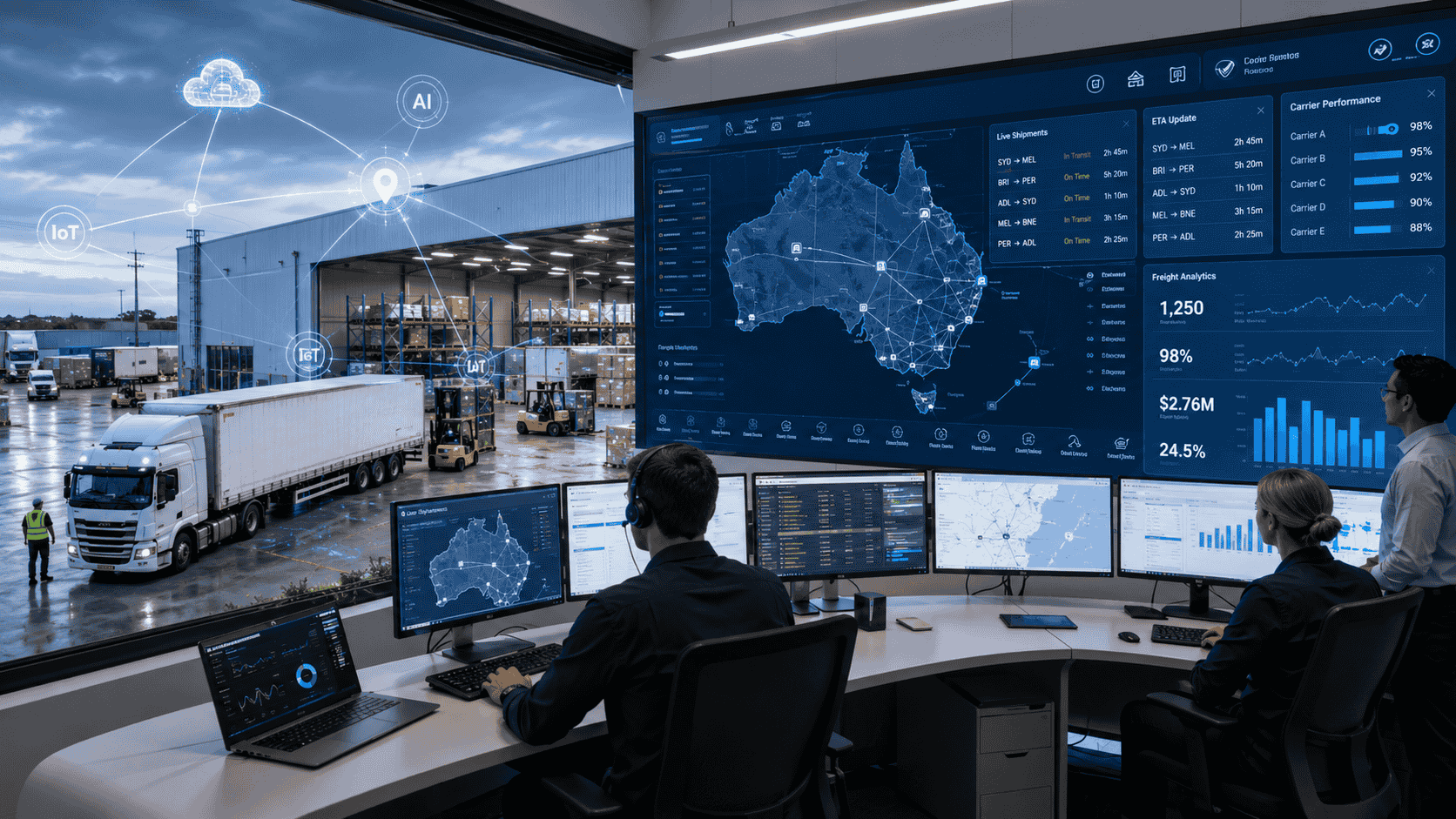
But let’s be honest — Australia’s freight network isn’t a simple beast. It stretches across vast distances, from Brisbane’s port facilities to the mining roads of WA. So, the push for digital innovation has to balance cutting-edge technology with practical, boots-on-the-ground logistics.
Let’s unpack the technologies driving that change.
Core Digital And Analytical Technologies
The modern freight sector runs on data. From predicting next week’s demand to optimising the best route from Sydney to Perth, technology is the backbone that keeps everything moving efficiently. Below are the major innovations shaping the future of freight operations — both here and abroad.
Artificial Intelligence And Predictive Analytics
AI has become the industry’s quiet powerhouse. It’s working behind the scenes to forecast demand, fine-tune routes, and even predict equipment failures before they happen.
I once worked with a transport operator out of Melbourne who handled high-volume FMCG freight. Their old planning model relied on gut feel and last year’s sales data — not exactly a recipe for accuracy. After adopting predictive analytics, they could anticipate delivery peaks around holidays like Christmas and Easter weeks in advance. Their warehouse team finally had breathing room instead of scrambling to catch up.
Here’s what AI is doing right now in freight management:
Application | How It Works | Result |
Demand Forecasting | Analyses seasonal patterns, fuel costs, and order history. | Prevents overstocking or stockouts, improving cash flow. |
Route Optimisation | Uses traffic, weather, and driver data to calculate the fastest, most fuel-efficient paths. | Cuts travel time by up to 20%, saving thousands per year in fuel. |
Predictive Maintenance | Monitors vehicle sensors to spot wear or faults early. | Reduces breakdowns and improves fleet uptime. |
Dynamic Pricing | Adjusts rates based on demand and carrier performance. | Keeps freight costs competitive while protecting margins. |
In an Australian context, AI-powered routing can mean the difference between a two-day and a three-day delivery. On major freight corridors like Melbourne–Adelaide, those hours matter. It also helps reduce emissions, which is crucial as more carriers push toward carbon reporting under local sustainability targets.
Automation, Robotics, And Autonomous Vehicles
Automation isn’t about replacing people — it’s about helping them work smarter. Australian warehouses are leading the charge, with robotics increasingly taking on repetitive or heavy-lifting tasks.
In one Brisbane distribution centre, automated cranes and conveyors handle thousands of cartons daily, freeing staff to focus on exceptions and quality checks. The result? Fewer injuries, better accuracy, and faster turnarounds.
And while autonomous trucks might still sound futuristic, trials are well underway. In regional areas where long-haul fatigue is a safety concern, autonomous vehicles have the potential to run almost continuously, with remote supervision. This could ease driver shortages — a major issue across our industry — and reduce the risk of fatigue-related accidents.
Let’s look at where automation is making the biggest difference:
Warehouse Robotics – Automated picking systems and AMRs (autonomous mobile robots) increase throughput and accuracy.
Autonomous Vehicles – Self-driving trucks and delivery units are being tested for controlled routes, especially between ports and distribution hubs.
Rail Automation – Digital coupling systems and AI-assisted scheduling can increase freight rail efficiency by up to 30%.
These technologies don’t just save time — they address Australia’s persistent challenge: distance. Covering thousands of kilometres of road each week, automation helps freight companies operate more consistently and safely over long routes.
Real-Time Visibility, IoT, And Cloud Computing
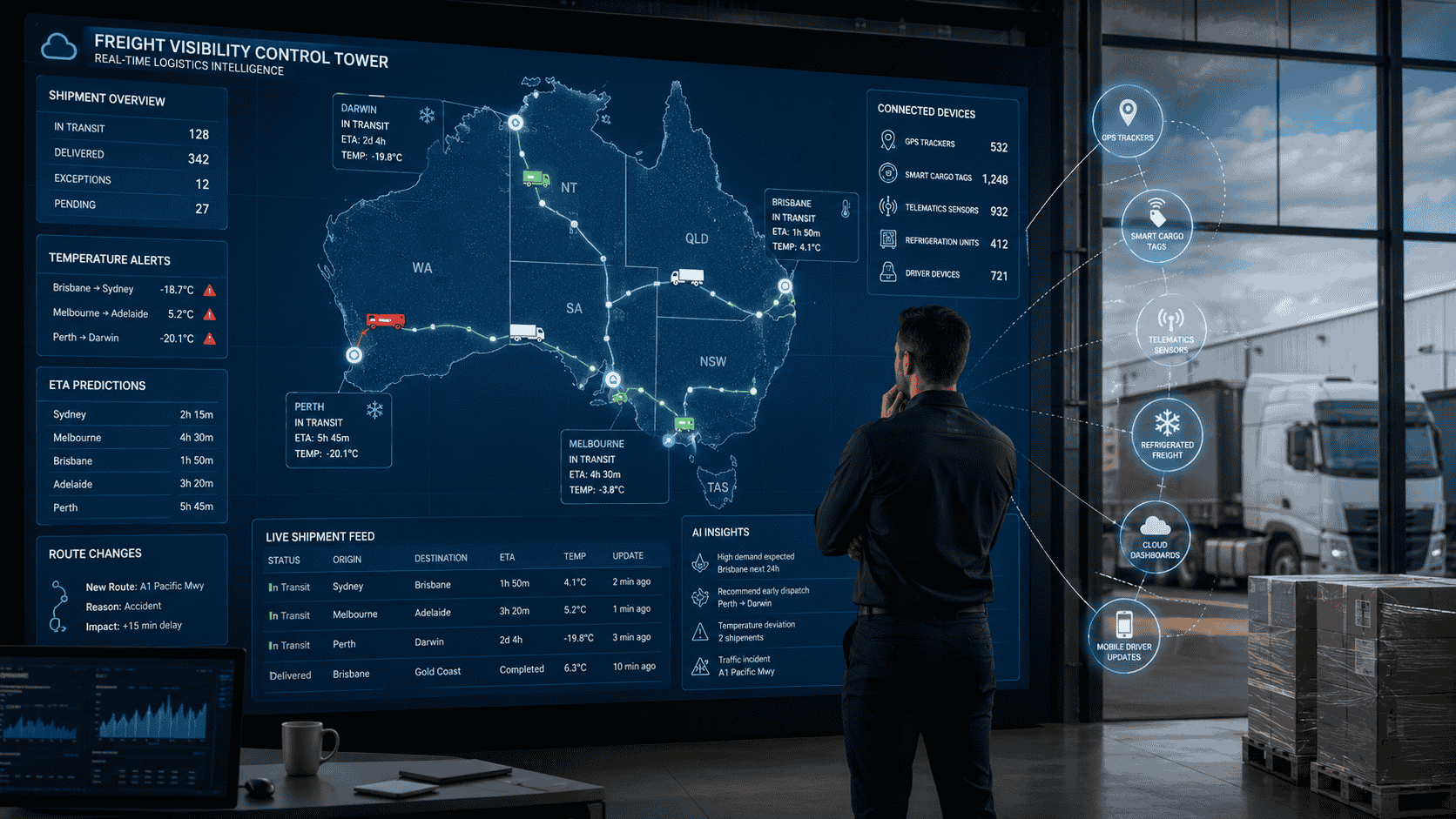
If you’ve ever tried to explain to a frustrated customer why their shipment hasn’t arrived — without any real tracking data — you’ll understand just how valuable visibility has become in freight. Those days of guesswork are quickly disappearing, thanks to IoT sensors, real-time tracking, and cloud-based systems that link every step of the journey.
When I was consulting for a national transport operator a few years back, they struggled with missed handovers between depots. Drivers would arrive, paperwork wouldn’t match, and pallets would sit idle for hours. Once they rolled out IoT-enabled tracking tags and cloud integration between their depots, it was like someone switched on the lights. Everyone — from operations to customer service — could see exactly where each shipment was and what was holding it up. Within three months, their delivery reliability jumped from 82% to 96%.
How IoT And Telematics Connect The Supply Chain
IoT (Internet of Things) devices — like GPS trackers, telematics sensors, and smart tags — now bridge the physical and digital sides of freight. These tools capture real-time data such as vehicle speed, cargo temperature, and fuel levels, sending it instantly to cloud dashboards.
By 2026, analysts predict that one in four global shipping containers will include telematics hardware. In Australia, this will be particularly useful for monitoring refrigerated freight on long-haul routes from Queensland to Western Australia, where extreme temperatures can make or break a delivery.
Benefits Of IoT And Real-Time Tracking:
Enhanced transparency: Everyone — shippers, carriers, and receivers — can view shipment progress in real time.
Faster decision-making: If a route is blocked by weather or road closures (think summer bushfires or flooding in regional NSW), dispatchers can instantly reroute drivers.
Improved customer satisfaction: Clients receive accurate ETAs, not vague “sometime this afternoon” updates.
Reduced losses: Cargo theft and spoilage are cut dramatically with constant monitoring.
IoT-powered visibility is especially vital for industries moving sensitive goods — pharmaceuticals, fresh produce, and even mining parts that can cost hundreds of thousands of dollars each.
The Role Of Cloud Computing And 5G
The real game-changer, though, is how cloud computing and 5G tie everything together. Instead of siloed spreadsheets or outdated TMS databases, modern systems store and share data across the entire supply chain.
Here’s what that looks like in practice:
A carrier in Adelaide updates load status via mobile; that information instantly syncs with a shipper’s ERP in Sydney.
A driver in Port Hedland uploads proof of delivery, triggering automated invoicing — no paperwork needed.
A 5G-enabled network transmits location data in seconds, even in regional zones that previously struggled with coverage.
For Australia’s vast freight landscape, this connectivity is critical. Whether it’s a refrigerated trailer crossing the Nullarbor or a local courier run through Melbourne’s CBD, data moves just as efficiently as the freight itself.
Blockchain And Transparency
Transparency has always been a sticking point in logistics. Too often, multiple parties — carriers, brokers, customers — work from different data sets, creating confusion and delays. Blockchain is now reshaping that by providing a single, immutable source of truth for every transaction.
Think of blockchain as a digital ledger where every freight movement, invoice, and document is recorded and verified by all parties involved. It’s tamper-proof, timestamped, and easily auditable. That means fewer disputes, faster settlements, and greater confidence that what’s been recorded actually happened.
Here’s a simplified example:
A freight forwarder moves a high-value electronics shipment from Brisbane to Auckland. Each checkpoint — warehouse entry, customs clearance, and vessel loading — automatically adds a blockchain entry. Every stakeholder, from the exporter to the consignee, can view these updates instantly. If there’s a delay, the reason is visible to everyone. No need for a dozen phone calls or spreadsheets to track it down.
Why Blockchain Matters In Freight:
Enhanced Traceability: Each movement is recorded permanently, improving accountability.
Data Security: Decentralised ledgers prevent tampering and protect sensitive shipment details.
Faster Payments: Smart contracts automatically trigger payments once delivery conditions are met.
Reduced Fraud: Fewer opportunities for document manipulation or false declarations.
Although still in its early stages in Australia, blockchain is gaining traction in international freight, particularly for import/export processes where documentation is complex and fraud risks are high. As adoption grows, we’ll likely see customs, ports, and transport authorities standardise blockchain-enabled data exchange, streamlining cross-border operations even further.
Digital Platforms And Future Technologies
If you’ve been around freight long enough, you’ll remember the days of ringing carriers for quotes, waiting hours for replies, and juggling paper dockets that inevitably got lost in the cab. Those manual processes are fading fast as digital freight platforms and transportation management systems (TMS) reshape how we run freight operations.
These systems are more than just convenient — they’re transformative. They connect shippers, carriers, and receivers through one digital ecosystem, reducing phone calls, improving visibility, and cutting administration overheads.
I worked with a mid-sized freight broker based in Newcastle that used to manage bookings through email and spreadsheets. After moving to a digital platform with live pricing and automated carrier matching, they reduced their admin workload by almost 40% and doubled their daily booking capacity without adding staff. The change freed up time for customer service — and that’s where the real business growth came from.
Digital Freight Matching (DFM) And Transportation Management Systems (TMS)
Digital Freight Matching and TMS platforms are the backbone of the freight tech movement. Together, they automate the most time-consuming parts of logistics: finding carriers, booking loads, tracking shipments, and handling paperwork.
Digital Freight Matching (DFM)
DFM platforms use algorithms to automatically match available freight with carriers that have the right capacity, location, and service profile. It’s a bit like rideshare tech — but for trucks.
In practical terms, this reduces the number of empty runs and helps carriers backfill loads to avoid wasted kilometres. Given how costly fuel is in Australia, especially across long interstate routes, that efficiency translates to real money saved and lower emissions.
Key Advantages of DFM Platforms:
Faster Load Matching: Real-time algorithms pair shippers and carriers in seconds.
Reduced Empty Miles: Optimises backhauls and improves vehicle utilisation.
Data-Driven Insights: Aggregates pricing, lane performance, and carrier reliability metrics.
Lower Administrative Load: Cuts manual processes like rate confirmations and proof-of-delivery chasing.
The DFM market is projected to reach USD 247.6 billion globally by 2030, and Australia’s share of that growth will be significant as more local operators move to digital-first freight systems.
Transportation Management Systems (TMS)
TMS platforms have evolved from basic route planners to fully integrated logistics command centres. Modern, cloud-based systems can handle quoting, route optimisation, compliance tracking, and invoicing — all in one interface.
A good TMS gives you the full picture: shipment visibility, carrier performance data, and cost breakdowns at a glance. For multi-depot operations or 3PL providers, that’s invaluable.
In Australia, where freight often involves multiple modes — road, rail, and sea — TMS integration is key to connecting data across all touchpoints. It ensures nothing slips through the cracks between ports, depots, and end customers.
Typical TMS Features Table:
Feature | Benefit | Local Example |
Route Optimisation | Reduces transit times and fuel usage | Optimising Sydney–Melbourne freight lanes |
Carrier Performance Tracking | Improves accountability and reliability | Ensuring subcontractors meet KPIs on time |
Enables live ETA updates for customers | Tracking farm produce from Mildura to Melbourne | |
Compliance and Documentation | Keeps up with Chain of Responsibility (CoR) laws | Automating fatigue and load mass reports |
Australian freight operators, in particular, value TMS systems that support Chain of Responsibility reporting — especially given the legal liabilities around driver fatigue and vehicle mass compliance. It’s one of those areas where technology directly supports regulatory safety outcomes.
Advanced Interoperability And Digital Transformation
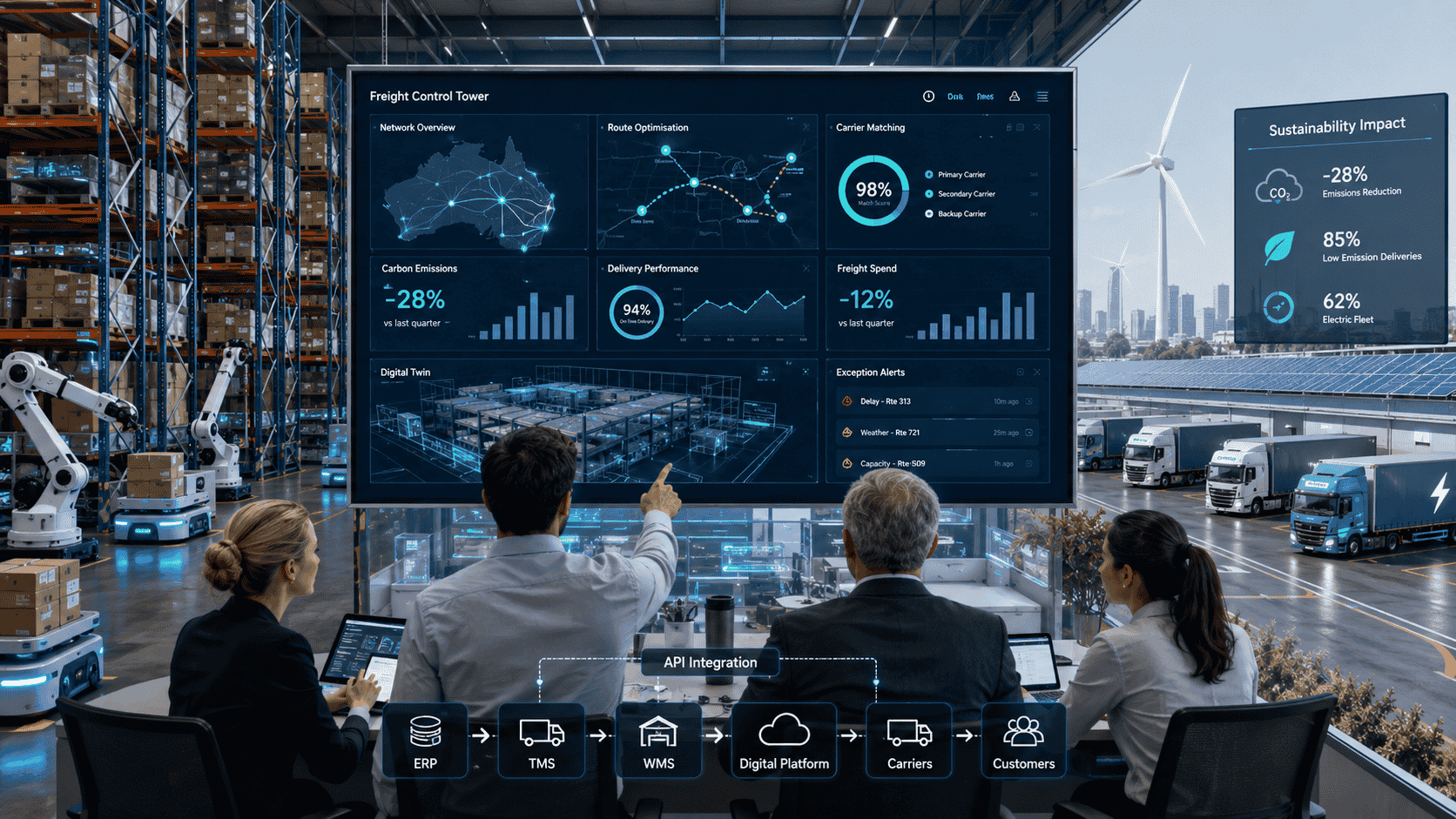
Technology only works well when systems talk to each other. Interoperability — the ability for systems to share and interpret data — has become the cornerstone of digital freight transformation.
API Integration
Modern freight technology relies on Application Programming Interfaces (APIs) to connect systems such as TMS, ERP, and carrier portals. APIs make sure that when one system updates (say, a carrier completes a delivery), all connected systems update automatically.
For instance, a manufacturer in Geelong might run its ERP in SAP, manage transport through a TMS, and outsource deliveries to regional carriers. With proper API integration, the warehouse, transport team, and finance department see the same data in real time. No more mismatched invoices or double data entry.
Digital Twins
Digital Twins are another exciting innovation. These are real-time virtual replicas of your physical logistics operations — from warehouse layouts to fleet networks. They simulate different scenarios, allowing you to test decisions before applying them in the real world.
For example, a national grocery distributor can use a Digital Twin to model what happens if a Brisbane distribution centre shuts down during a flood. The simulation can instantly test rerouting options through Sydney or Townsville and calculate the cost and delivery impact before making the call.
Everyday Use Cases for Digital Twins:
Predicting supply chain disruptions (e.g., floods, strikes, or port congestion).
Testing warehouse design layouts for efficiency.
Optimising national route networks before seasonal peaks.
Augmented Reality (AR) In Logistics
AR might sound like a tech gimmick, but in logistics, it’s proving incredibly practical. Warehouse staff using smart glasses can locate items faster and pick with fewer errors. Drivers can use AR heads-up displays for navigation or maintenance guidance — reducing downtime and human error.
I saw a pilot trial in a Perth warehouse where AR headsets guided new recruits through complex pick sequences. Within two weeks, their accuracy rates matched seasoned operators. That’s the sort of real-world advantage that pays for itself quickly.
Electrification And Sustainability
Sustainability isn’t just a buzzword in transport anymore — it’s fast becoming a licence to operate. Across Australia, freight operators are under increasing pressure from customers, investors, and regulators to prove they’re cutting emissions and improving environmental performance.
I remember chatting with a fleet owner in Adelaide who summed it up well: “Five years ago, no one asked me how green my trucks were. Now, it’s on every tender.” That shift says it all.
The freight industry contributes around 8% of Australia’s total greenhouse gas emissions, largely from diesel trucks running long interstate hauls. While that figure sounds daunting, technology is helping the sector move in a cleaner direction.
Electrification Of Freight Fleets
Heavy-duty electric vehicles
https://arena.gov.au/news/arena-investment-helps-freight-shift-from-diesel-to-electric-trucks/ |
(e-HDVs) are starting to appear on Australian roads, particularly in metro delivery fleets where shorter routes and return-to-base operations make recharging practical.
States like New South Wales and Victoria are already trialling electric heavy vehicles in urban freight corridors. And while adoption is slower in regional areas due to range and charging limitations, the shift is inevitable — especially as battery efficiency improves and charging networks expand.
Infrastructure And Investment Challenges
Rolling out large-scale electrification isn’t simple. Freight operators face several hurdles before e-trucks can become mainstream:
Challenge | Description | Australian Context |
Charging Infrastructure | Lack of high-capacity chargers suitable for heavy vehicles. | Few public HPC sites exist between Sydney and Brisbane freight routes. |
High Capital Costs | e-HDVs cost two to three times more upfront than diesel equivalents. | SMEs struggle with finance approval for fleet replacement. |
Grid Capacity | High energy demand for fleet charging may strain local networks. | Industrial estates near Port Botany are already reviewing substation capacity. |
Long Project Timelines | Permits, installation, and upgrades can take months. | Regional depots often wait 12–18 months for approvals. |
Governments are beginning to step up. The Australian Renewable Energy Agency (ARENA) has co-funded trials for heavy-vehicle charging stations, and several state governments offer grants for zero-emission freight projects. But to make this work at scale, private operators, energy providers, and regulators will need to collaborate closely — something Australia hasn’t always excelled at.
Operational Optimisation
It’s not just about replacing diesel with electricity — it’s about running electric fleets smarter. Software is helping operators optimise routes to match vehicle range, traffic, and terrain, preventing low-battery incidents.
Drivers can also plan trips around regenerative braking zones (like downhill segments along the Hume Highway) to recover energy and extend range. In city logistics, electric trucks are proving ideal for night-time deliveries due to their near-silent operation, reducing urban noise complaints — a bonus few expected.
The Push For Greener Supply Chains
Sustainability now goes well beyond vehicle emissions. Many Australian businesses are setting Scope 3 emissions targets, which include the transport services they use. That means freight operators must demonstrate carbon reduction credentials to stay competitive in tenders.
Forward-thinking companies are using digital analytics to measure and offset freight emissions. By combining GPS data, load weights, and fuel efficiency figures, these platforms can calculate CO₂ output per shipment and generate verifiable reports for clients.
Here’s a quick Sustainability Action Checklist many operators are using to stay ahead of the curve:
Freight Sustainability Action Checklist:
Conduct a Fleet Emissions Audit – Identify high-consumption vehicles and prioritise replacements.
Adopt Route Optimisation Software – Reduce unnecessary kilometres.
Explore EV or Hybrid Options – Start with urban delivery vehicles.
Implement Driver Training Programs – Eco-driving can lower fuel use by 10–15%.
Collaborate with Clients on Consolidation – Reduce partial loads and improve efficiency.
Offset Emissions Transparently – Use verified carbon offset schemes.
Monitor Results Digitally – Track sustainability KPIs monthly.
Many operators who take this approach find that sustainability actually cuts costs. Less idling, smarter route planning, and efficient load management all reduce diesel spend — it’s a win for the planet and the profit margins.
Looking Ahead
The freight sector’s sustainability journey is a marathon, not a sprint. But with government pressure mounting and technology costs dropping, electrification and clean logistics will become standard within the next decade.
Based on current adoption rates, I’d expect:
Urban e-fleet dominance by 2030, especially for parcel and retail deliveries.
Regional and long-haul electric trials scaling from 2032, once battery ranges exceed 1,000 km.
Mandatory emissions reporting by 2035, aligning with broader Australian environmental policies.
Those who start preparing now — investing in infrastructure, upskilling staff, and integrating sustainability into their digital strategy — will find themselves miles ahead when the regulatory spotlight intensifies.
Challenges To Technology Adoption
For all the buzz around, the reality on the ground is more complex. The freight industry doesn’t switch overnight. I’ve sat in boardrooms where operators are excited about automation — until they see the implementation costs. Then it’s a different conversation.
The truth is, many transport businesses across Australia still rely on paper manifests, faxed invoices, and a “she’ll be right” attitude toward process improvement. The technology is there — but adoption takes more than just buying new software. It’s about culture, training, and mindset.
Let’s look at what’s slowing the pace of change.
1. High Costs And Roi Uncertainty
Implementing freight technology is an investment — and for small to mid-sized operators, it can feel like a gamble. Software licences, new telematics hardware, data migration, and employee training add up quickly.
A regional carrier in Dubbo once told me their biggest fear wasn’t the software cost — it was the downtime during changeover. For businesses running razor-thin margins, even a few days of disruption can hurt.
The key is starting small: automate the highest-friction areas first (like quoting or proof-of-delivery) and expand once you see measurable gains. Most operators who take that step-by-step approach see ROI within 12–18 months.
2. Legacy System Integration
Australia’s freight sector is riddled with legacy systems — old ERPs, outdated TMS platforms, or worse, siloed spreadsheets. Integrating new digital tools with these older systems can feel like trying to run modern freight tracking on a dial-up modem.
Without proper API integration, data gets trapped. You end up with double entries, inconsistent load records, and frustrated staff. The fix isn’t glamorous, but it’s crucial: invest in integration middleware or upgrade systems gradually to ensure data flows freely.
I worked with a freight forwarding business in Melbourne that struggled to reconcile accounts because their TMS couldn’t communicate with their finance software. Once they introduced an API bridge, the number of invoice disputes dropped by 70% in the first quarter.
3. Workforce Resistance And Skills Gaps
Here’s a common one — technology fear. I’ve met dispatchers who’ve been on the job for 20 years and know every carrier by heart. To them, automation feels like an insult to their experience.
Resistance isn’t about capability — it’s about confidence. The best digital transformations I’ve seen focus on inclusion, not replacement. That means training sessions, open discussions, and showing staff how tech actually makes their day easier.
We’re also facing a national digital skills shortage. According to the Australian Industry and Skills Committee, the logistics sector will need over 40,000 additional workers with digital and analytical skills by 2030. Without structured training, even the best tech investments can fall flat.
4. Cybersecurity Risks
As freight systems become more connected, they become more vulnerable. Telematics devices, cloud software, and IoT sensors create digital entry points for hackers. Cyberattacks targeting logistics firms are on the rise, particularly ransomware incidents that freeze access to critical data.
In 2024, a Queensland-based transport company had to suspend operations for nearly a week after a cyber breach compromised its driver database. The financial loss was severe — but the reputational damage was worse.
Every freight operator — regardless of size — should have a cybersecurity checklist in place:
Freight Cybersecurity Essentials:
Use multi-factor authentication (MFA) across all systems.
Encrypt customer and vehicle data.
Regularly back up operational databases offline.
Conduct staff phishing-awareness training.
Maintain incident response and recovery protocols.
It’s not paranoia — it’s preparation.
5. Lack Of Standardisation
Ask any carrier or freight forwarder, and they’ll tell you: no two systems talk the same language. Data formats, labelling conventions, and documentation standards vary wildly between carriers, warehouses, and customers.
This lack of standardisation creates inefficiency and cost. The industry needs clearer frameworks — ideally led by industry associations or regulators — to streamline electronic data interchange (EDI) and digital proof-of-delivery formats.
The good news? Several Australian logistics bodies are already working on common data models to simplify freight communication, particularly for intermodal freight where road, rail, and sea operators share data.
6. Regulatory Uncertainty
Technology often moves faster than legislation. Autonomous vehicles, blockchain, and AI-based decision systems all sit in grey zones when it comes to regulation.
For instance, while Australia has begun setting AV testing guidelines, there’s no unified federal framework for autonomous truck operations. Similarly, blockchain-based documentation isn’t yet legally recognised in all freight transactions, leaving businesses hesitant to fully commit.
Until these gaps close, companies are left weighing innovation against compliance risk. The smartest move for now is to engage with regulators early — join pilot programs, participate in consultation rounds, and make sure your voice helps shape the future rules.
Technology in the freight industry isn’t just changing the tools we use — it’s reshaping how we think about logistics altogether. From AI-driven route optimisation to electric fleets and real-time IoT tracking, digital transformation is turning freight from a reactive process into a proactive one.
Still, success depends on more than innovation — it requires leadership, collaboration, and a willingness to adapt. The companies thriving in this new era are those that treat technology as a long-term strategy, not a short-term fix.
As someone who’s seen the freight sector evolve over two decades, I can say this much: the operators who invest in digital capability today will own the market tomorrow. Those who don’t will be left idling on the hard shoulder.
Let's Get Straight To The Point
Freight technology — including AI, IoT, and automation — is transforming efficiency, transparency, and sustainability.
Real-time visibility, blockchain, and digital platforms are reshaping how supply chains communicate and perform.
Electrification and green logistics are gaining momentum, supported by data-driven sustainability reporting.
The biggest hurdles remain cost, integration, skills, cybersecurity, and unclear regulation.
Freight operators that embrace digital innovation early will gain a clear competitive advantage as the sector modernises.
Frequently Asked Questions
What Is Freight Technology And Why Is It Important?
Freight technology refers to digital tools and systems — such as AI, IoT, and logistics software — that automate and optimise freight operations. It’s essential because it improves efficiency, reduces costs, and provides visibility across the supply chain.
How Is AI Being Used In Freight Management?
AI is used for route optimisation, demand forecasting, predictive maintenance, and pricing analytics. In Australia, it’s helping carriers cut empty miles and improve delivery accuracy across long-distance freight routes.
What Are The Main Barriers To Freight Digitalisation?
Common obstacles include high upfront costs, legacy systems, staff resistance, cybersecurity risks, and unclear regulations. Many operators overcome these by starting small — automating one process at a time.
Is Electric Freight Viable In Australia?
Yes, particularly for urban and short-haul routes. As charging infrastructure expands and battery technology improves, electric heavy vehicles will become more common across interstate networks by the 2030s.
How Can Freight Operators Prepare For The Future?
Start by investing in digital visibility tools, training staff in data literacy, integrating systems via APIs, and building a sustainability roadmap. Early adopters will gain stronger margins and a market reputation for reliability.