

Why the Cheapest Freight Quote Isn’t Always the Best Carrier Choice
07 August 2026

See how Cario helps operations managers compare carrier quotes by cost, service and ETA confidence before booking freight.
The cheapest freight quote can cost more than you think

There is a particular kind of freight decision that looks perfectly sensible at 2:45 on a Tuesday afternoon. You have six consignments left to book before the carrier cut-off, the warehouse wants them gone, one customer has already asked for an ETA and sales has promised another order will be there by Friday. Three carrier options come back. One is $22 cheaper. Same destination, similar-looking service, delivery date looks fine, so you book it.
Then Thursday comes around and the freight is still sitting in transit. Customer service is asking for an update, sales wants to know what happened to Friday, someone in the warehouse is checking whether the correct carrier was used, and operations is on the phone trying to work out whether the freight is late, lost, sitting in a depot or simply hasn’t had a scan. That $22 saving disappeared a while ago.
I have seen versions of this play out countless times in freight. It is rarely because someone made a stupid decision; they made the best decision they could with the information in front of them. Quite often, the quote table told them which carrier was cheapest. It did not tell them much about the likelihood of that carrier actually meeting the date on the screen, and that matters.
A freight rate is only one part of the decision
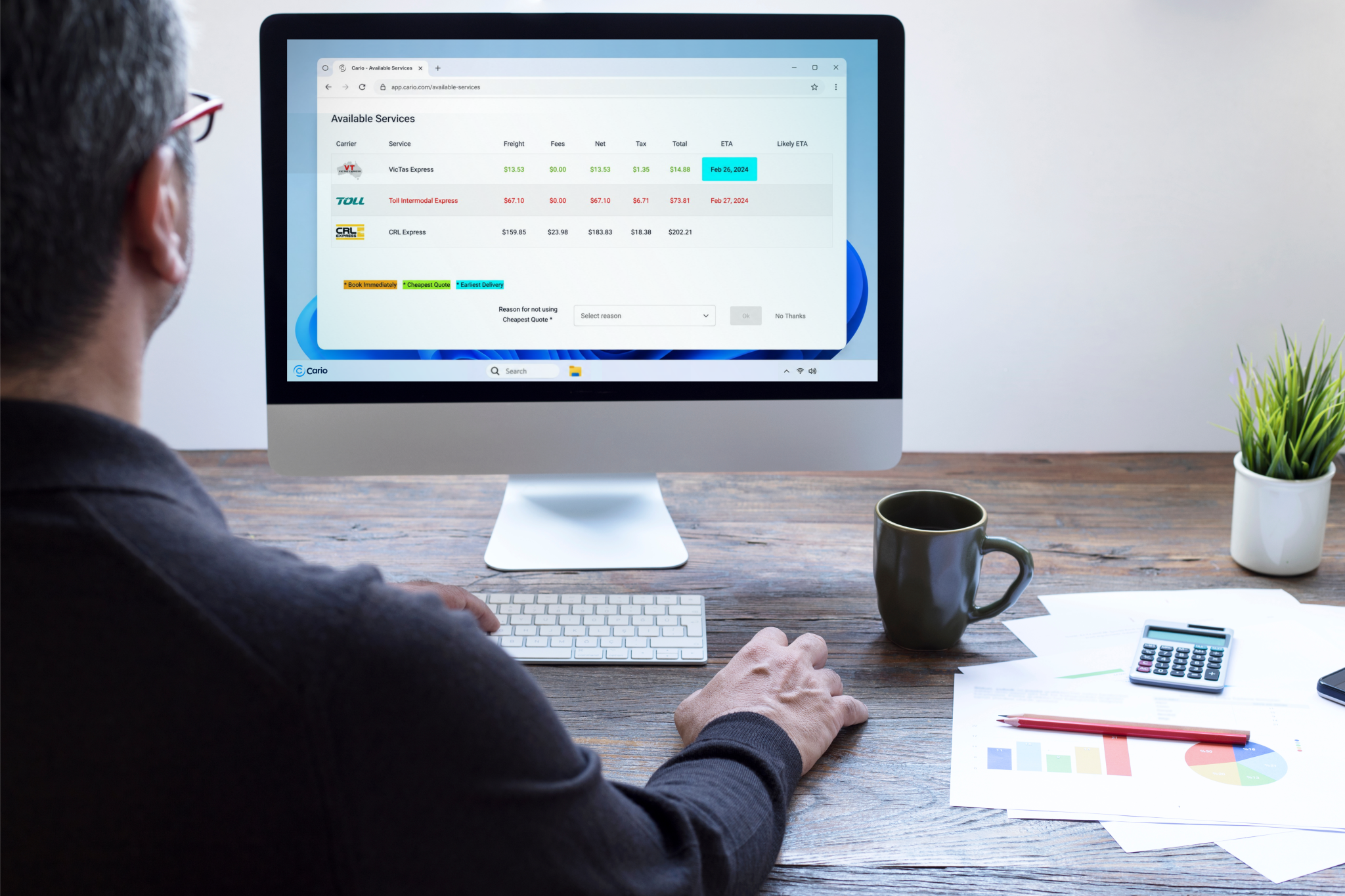
Spare a thought for the operations manager for a second, because they get squeezed from every direction. The warehouse needs freight off the floor while finance wants freight spend under control. Sales wants delivery dates it can give customers with some confidence. Customer service does not want to spend tomorrow morning chasing yesterday’s freight, so naturally, they chase you.
The customer generally does not care about any of this. They do not care that Carrier A was $22 cheaper than Carrier B; they care that someone told them Thursday and the order turned up Monday. Price matters, obviously, and if you can move the same freight on the same service for less money, take the saving. But oils ain’t oils, and “same service” is doing a fair bit of heavy lifting there.
A freight quote might show a rate of $148 and an ETA of Thursday, while another shows $171 and the same ETA of Thursday. On paper, that looks like an easy decision. In practice, one carrier may have a very strong record into that postcode while the other regularly slips a day or two. Once you know that, it is a different decision.
Australia makes this harder than it looks
Australia is the greatest country in the world, and I’ll tell anyone that, but for freight we are also a big desert rock with the vast majority of us living on the little green edges. That is not the easiest setup for moving things around, and Australian freight has its own little traps because of it.
Sydney to Melbourne is one thing; Melbourne to Wagga Wagga is another. Sydney to Dubbo is not Sydney to Orange, despite both looking like a regional NSW job on a spreadsheet. Then throw in Perth, North Queensland during the wet, Easter, Christmas, a Monday public holiday, or that week every customer suddenly remembers they need stock before shutdown.
A delivery estimate can look beautifully precise on a screen while the actual trip is anything but. Experienced operations people know this, which is why they build up their own mental map over time. They know which carrier is strong into Adelaide, who they trust for metro Brisbane, and which service they would happily use for a non-urgent pallet into Newcastle but might avoid for something tied to a site installation in regional NSW.
There is real value in that knowledge. The problem is that it often lives in somebody’s head.
“Ask Mick, he knows which carrier to use”
Most freight teams have a Mick, or a Janet, or a Dave to get on the phone when things go pear-shaped. Maybe it is the warehouse supervisor, maybe it is the transport coordinator, or perhaps the person who has booked freight for the company since 2009. They can tell you cold, without opening a spreadsheet, which carrier will have trouble getting into a particular part of South Australia.
That works until Mick is on leave, leaves for good and gets to enjoy retirement, the company adds another warehouse, or order volumes double in November. Then the unwritten freight rules start showing their age.
I have always liked operational knowledge that can survive the person who originally learned it, and carrier selection is a good example. The aim is not to get rid of judgement because good freight people will always use judgement. The aim is to give them better information when they make the call.
What Cario’s ETA indicators add
When Cario returns carrier options during Quick Quote or consignment creation, users can already compare the practical booking information in front of them: carrier, service, freight cost, fees, total cost and expected delivery timing. ETA indicators add another useful question to that comparison: how much confidence should I put in that delivery date?
Cario can use carrier-provided ETA information where it is available, as well as historical delivery performance and relevant delivery trends to provide more context around the expected date. Instead of looking at three services that simply say Thursday, Thursday and Wednesday, an operations team can see more of the story behind those dates.
Carrier |
Cost |
ETA |
ETA context |
Carrier A |
$148 |
Thursday |
Lower confidence |
Carrier B |
$171 |
Thursday |
Likely to meet ETA |
Carrier C |
$183 |
Wednesday |
Estimated ETA |
Now there is something to discuss. If the freight is flexible, Carrier A might still win, and you take the $23 saving. If the freight is for a builder waiting on site at 7 am Friday morning, you may make a different call. It is the same quote table, but with better context.
A real-world example
Say you are sending a pallet from Melbourne to a regional NSW customer who is fitting the goods on Friday. Your carrier options come back on Tuesday afternoon.
Option one is $164 with an ETA of Thursday. It is the cheapest option, but historical performance suggests that date may be optimistic.
Option two is $191, also with an ETA of Thursday. In this case, the carrier supplied the ETA, and past delivery performance supports it.
Option three is $205 with an ETA of Friday. It gets there on the day you need it, but leaves no buffer if anything goes wrong.
Which one do you book? There is no universal answer. If the customer tells you, “Mate, Friday or Monday makes no difference” - take the $164 option if the service otherwise stacks up. If six installers are arriving Friday morning and the customer is paying them by the hour, the extra $27 for Option Two starts to look pretty cheap.
That is what freight optimisation tends to look like in the real world. It is rarely as simple as “pick the cheapest”. You work out what this particular delivery needs, what happens if it goes wrong, and spend accordingly.
What the ETA indicators mean
Cario uses several ETA indicators to give users more context around the date shown in the quote.
Likely meeting ETA
The carrier has provided the ETA and historical performance supports that delivery expectation. It does not turn the ETA into a guarantee, but it tells the user there is evidence behind the date.
Unlikely to meet ETA
Historical performance suggests the carrier may struggle to meet the displayed ETA for that service, location or a similar lane. That does not automatically mean “do not use this carrier”. The job might not be urgent, the saving might be substantial, or the customer might have plenty of stock. It means you can make the choice with your eyes open.
Likely ETA estimate
Cario has calculated an expected ETA using historical information such as previous performance for the service, similar services or comparable delivery locations. It is useful guidance, but it is still not a guarantee.
Freight still has freight problems. Bad weather happens, trucks break down, depots get busy, incorrect weights and dimensions create issues, customers give the wrong address, and Christmas arrives every year and somehow still surprises everybody. The indicator simply gives you another signal before you press book.
Think about the cost of being wrong
This is the part that often gets missed because freight cost is easy to measure. The invoice says $164, and there it is in black and white. The cost of a poor carrier decision is much harder to see because it gets spread all over the business.
A late delivery might create a customer service call, three internal emails, a carrier follow-up, a warehouse investigation, a sales escalation, a redelivery, a credit request and an unhappy customer. Nobody adds all of that up and attaches it to the original freight quote, but the business still pays for it.
I have seen teams spend half an hour chasing a consignment to explain why they saved twenty bucks sending it in the first place. Do that once and it is irritating. Do it 40 times a month and suddenly you have half the team wasting time chasing freight. That is operational drag.
Use a simple rule before booking
Operations teams do not need another 14-step process before they send a carton to Parramatta. The decision can stay simple, and five questions will get you a long way.
1. Does this freight actually need to arrive on time?
Some freight does and some freight just needs to arrive. Know the difference.
2. What happens if the carrier misses the date?
A replenishment order with three weeks of stock remaining is very different from equipment needed for tomorrow’s installation.
3. How much am I saving?
Saving $180 might justify taking a little more risk. Saving $7 probably does not if the delivery matters.
4. What does the ETA information tell me?
Check whether the date is carrier-provided, historically supported or estimated.
5. Would I still make this decision if the customer rang me tomorrow?
That last one is useful. If you would feel comfortable explaining why you picked the service, you probably made a defensible call.
Sometimes the cheapest carrier SHOULD win
There is a danger in talking about service performance as if spending more always produces a better result. It absolutely can, but often it does not. A higher rate is not a certificate of competence, and plenty of lower-cost carrier services perform exceptionally well on the right freight and the right lanes.
If your Sydney customer has flexible timing, the cheapest suitable service may be exactly what you want. If you are moving repeat freight on a lane with strong historical performance, keep taking the saving. The value of ETA information is not that it tells people to spend more; it can just as easily tell you when you do not need to.
Twenty dollars here, seven dollars there and forty dollars on the next consignment does not look like much one booking at a time. Across hundreds or thousands of consignments, it adds up pretty quickly.
Freight decisions get better when the context arrives before the problem
A lot of freight management is still reactive. The delivery misses its ETA, somebody looks at tracking, somebody contacts the carrier, the customer rings and suddenly everyone is on it. By that stage, though, the interesting decision happened three days ago when somebody picked the carrier.

That is the point where better information has the most value. Cario’s ETA indicators bring more of that context into the booking decision itself, so teams can compare cost, service and delivery confidence before the consignment leaves the warehouse.
Sometimes the cheapest option will still be the obvious choice. Other times, you will spend another $20 because this specific delivery matters. Both can be good freight decisions; the important bit is knowing why you made them.
See the full picture before you book
Cario brings carrier cost, service options and ETA confidence into one booking decision - so your team can choose the option that makes sense for this delivery, not simply the one with the lowest number beside it.