

Freight Cost Control Starts Before the Invoice
10 July 2026

See how Cario helps finance teams compare freight cost against ETA confidence before booking, so carrier decisions are easier to review and explain.
Freight Cost Control Starts Before the Invoice Arrives

Finance teams often see freight costs too late.
By the time the invoice lands, the carrier has already been chosen, the consignment has moved, and the delivery outcome has already affected the business.
That makes freight spend difficult to judge. A higher-cost carrier may look like overspending. A cheaper carrier may look like discipline. But without delivery context, finance only sees half the decision.
For finance leaders, the better question is:
Was the freight cost appropriate for the delivery risk?
Cario’s ETA indicators help answer that earlier. When teams compare carrier quotes, Cario shows the expected delivery date and whether the carrier is likely to meet it, using carrier-provided ETA information where available and historical delivery trends where relevant.
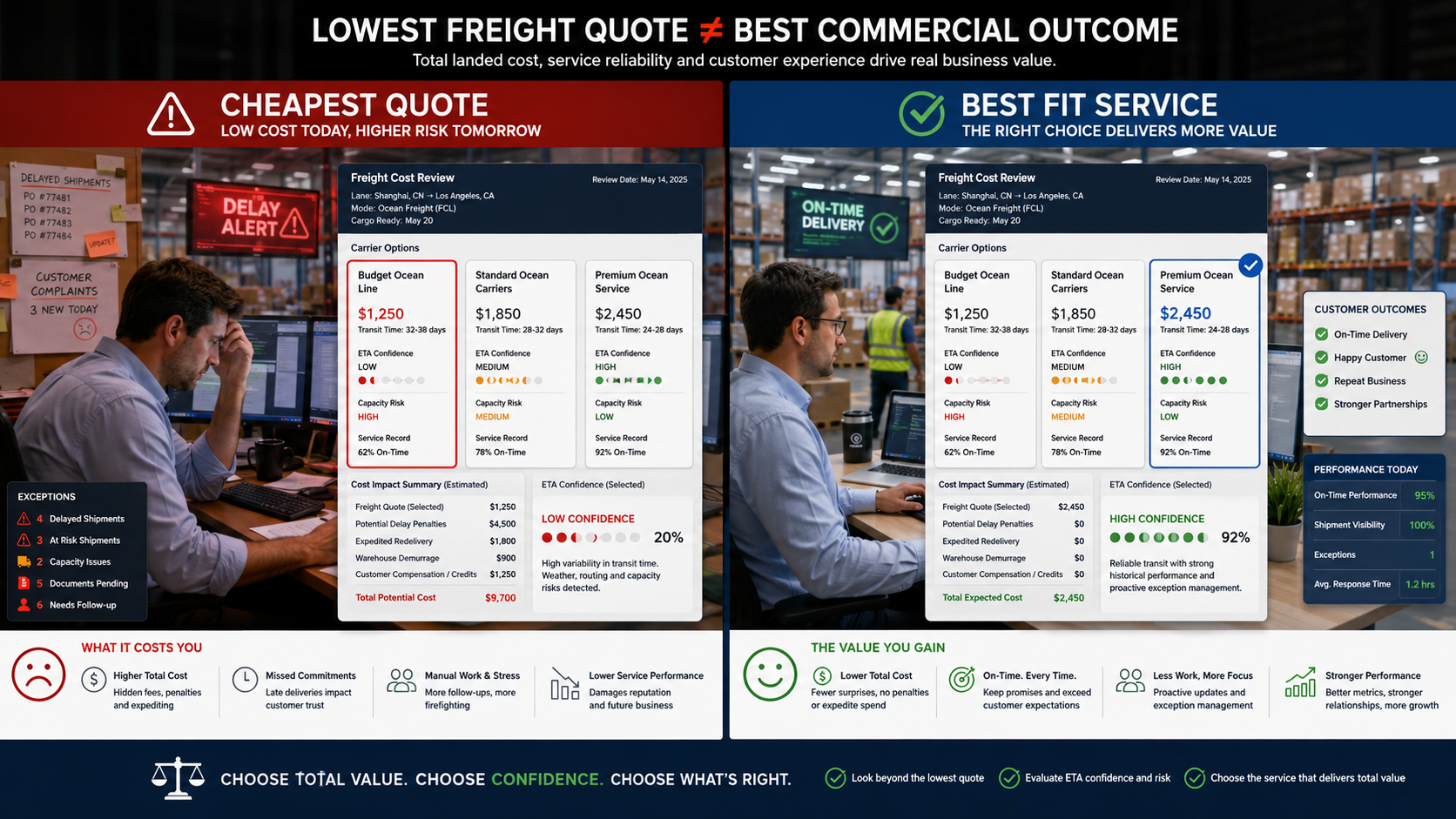
That gives finance a clearer view of why the lowest quote is not always the best commercial option.
The invoice does not tell the whole story
Freight invoices show what was charged.
They do not always show why the carrier was selected.
That creates a gap between finance and operations. Finance may question why a team chose a higher-cost service. Operations may know the reason, but the decision context can be buried in the day-to-day dispatch process.
ETA visibility helps close that gap.
If the cheapest service had a weaker likelihood of meeting the ETA, and the shipment was customer-critical, a higher-cost service may have been the more sensible choice.
That does not mean every urgent shipment should cost more. It means finance needs enough context to separate avoidable overspend from a justified service decision.
A better lens for freight spend
Traditional freight cost control often focuses on rate comparison:
Which carrier is cheapest?
A more useful finance lens adds service risk:
Which carrier gives the right balance of cost and delivery confidence?
Cario supports this by showing ETA indicators during Quick Quote and consignment creation. Once rates are returned, teams can compare pricing, fees, total cost and ETA information for each carrier service.
The indicators can show whether:
the carrier is likely to meet the ETA
historical performance suggests caution
the ETA is estimated from historical delivery data
This helps finance understand the trade-off before cost becomes an invoice issue.
Why this matters for finance leaders
Freight decisions affect more than the freight line item.
A poor carrier choice can create manual follow-up, customer complaints, delivery disputes and service recovery work. Those costs are harder to see than a freight charge, but they still affect the business.
ETA indicators give finance and operations a shared basis for discussion.
Instead of asking, “Why did we choose the more expensive carrier?” finance can ask, “Was the higher cost justified by the delivery requirement?”
That is a more useful commercial conversation.
It also helps finance identify patterns. If teams regularly avoid the cheapest carrier because ETA confidence is weak, that may point to a carrier performance issue, a customer service requirement, or a cost-to-serve problem worth reviewing.
What finance can do with better ETA context
Finance teams can use ETA visibility to support:
freight spend reviews
cost-to-serve discussions
carrier performance conversations
budget planning
customer profitability analysis
exception review with operations
For example, a customer with strict delivery expectations may regularly require carrier services with stronger ETA confidence. That should not be treated the same as routine freight with flexible timing.
Better context helps finance see the difference.
Cost control without false savings

The cheapest freight quote can still be the right choice.
But it should not win by default.
For routine shipments, a low-cost service may be suitable. For time-sensitive freight, a higher-cost option with stronger ETA confidence may protect the customer experience and reduce downstream work.
Cario’s ETA indicators do not guarantee delivery outcomes. Freight still depends on accurate declared weights and dimensions, carrier operations, service conditions, agreed terms, and check weight and volume.
But they do help teams make freight decisions with better information.
For finance leaders, that matters because true freight cost control starts before the invoice arrives.
Want better visibility into freight cost decisions before they become invoice questions?
Book a demo with Cario to see how finance and operations teams can compare carrier quotes by cost, service and ETA confidence.