

How to Reconcile Carrier Invoices and Take Control of Freight Spend
27 July 2026

See how Cario helps you reconcile carrier invoices
If your team is spending too much time reviewing freight invoices or struggling to track discrepancies, it’s worth seeing how a more structured approach works in practice.
Talk to our team to walk through your current process and where reconciliation can be simplified.
Freight invoices have a habit of creeping up on you.
One month everything looks fine. Next month, costs jump and no one can clearly explain why. Was it weight changes? Extra charges? Carrier errors? Or just normal variation?
For many Australian businesses managing multiple carriers, invoice reconciliation becomes a slow, manual task that sits between logistics and finance — and often falls through the cracks.

This is where having a structured reconciliation process makes a real difference.
Why Carrier Invoice Reconciliation Is So Difficult
On paper, reconciling freight invoices sounds straightforward:
Compare what you expected to pay
Compare what the carrier billed
Approve or dispute the difference
In reality, it’s rarely that clean.
Across a typical operation, you might be dealing with:
Multiple carriers with different pricing models
Hundreds or thousands of consignments per week
Variations in weight, dimensions and service types
Accessorial charges that only appear on invoices
Data spread across spreadsheets, carrier portals and internal systems
By the time invoices arrive, teams are left piecing together what actually happened.
Where Most Businesses Lose Control

Without a consistent process, invoice reconciliation usually breaks down in a few predictable ways:
1. Too Much Manual Checking
Finance teams spend hours matching invoices to shipment data line by line. It’s slow and prone to error.
2. No Clear View of Discrepancies
Differences exist, but they’re buried inside invoice PDFs or spreadsheets. Teams struggle to prioritise what matters.
3. Missed Overcharges
Small discrepancies get ignored. At scale, those small amounts can add up quickly.
4. Slow Internal Back-and-Forth
Finance needs answers from logistics. Logistics needs to check shipment details. Everything slows down.
5. Weak Freight Reporting
If invoices are not reconciled properly, reporting becomes unreliable. That makes it harder to track true freight spend.
What a Better Reconciliation Process Looks Like
A more effective approach focuses on visibility and control at the consignment level.
Instead of reviewing invoices as a lump sum, teams should be able to:
Compare expected vs invoiced cost for each shipment
Identify where and why charges differ
Focus only on meaningful discrepancies
Decide quickly whether to accept or question changes
Apply consistent decisions across large volumes
This shifts reconciliation from reactive admin to a structured workflow.
How Cario Supports Carrier Invoice Reconciliation
Cario approaches reconciliation as part of a broader freight management workflow.
Instead of working across disconnected systems, teams can review carrier invoices in the same environment where shipments were originally created.
At a practical level, this means:
Clear Cost Comparison
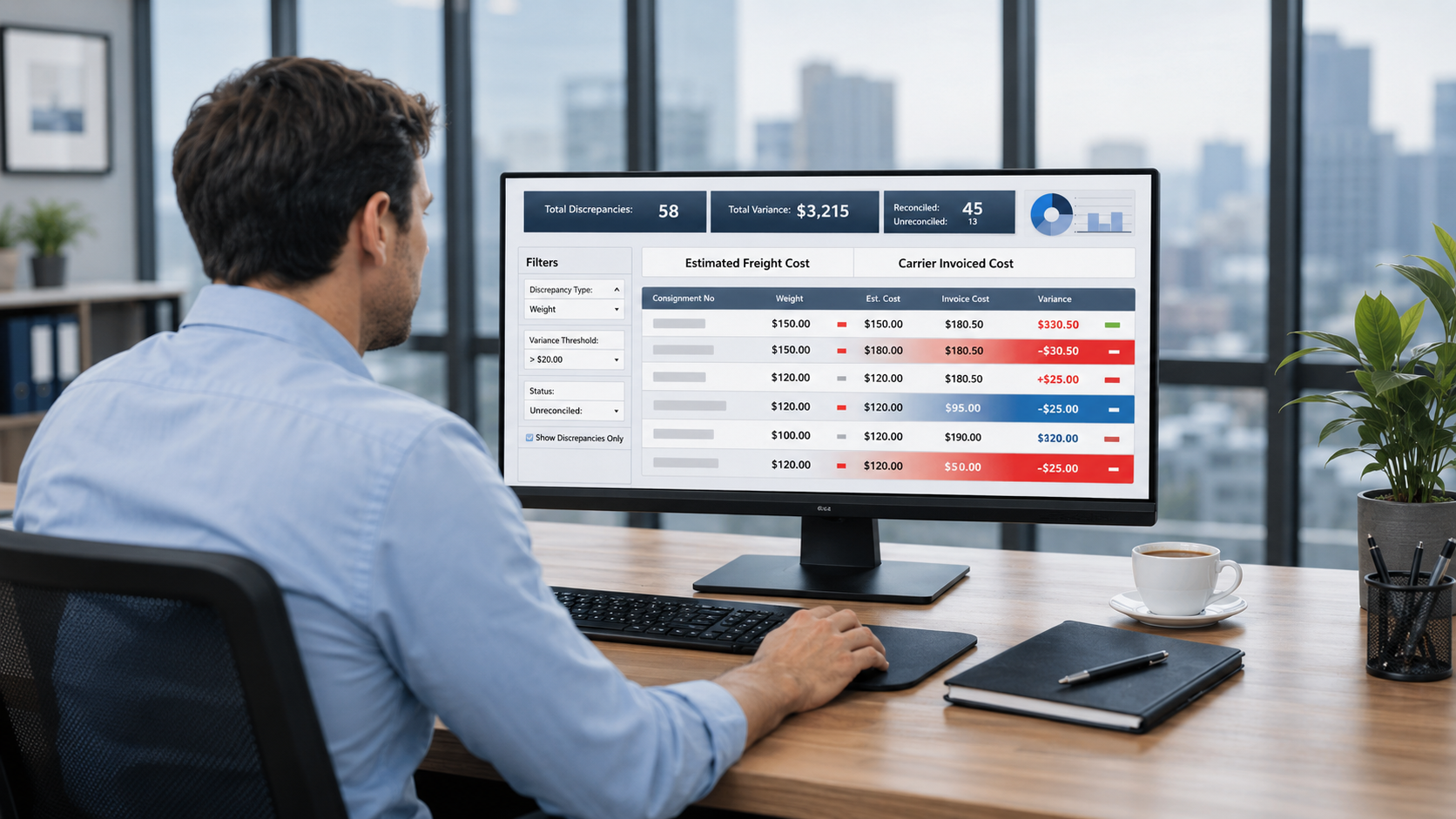
Teams can see estimated freight costs alongside carrier-invoiced costs for each consignment.
Discrepancy Visibility
Differences are highlighted so teams can quickly spot overcharges or unexpected changes.
Targeted Filtering
Users can filter by discrepancy type, thresholds, or reconciliation status to focus on what needs attention.
Consignment-Level Review
Shipment history is available when investigating a difference, helping teams understand what changed.
Controlled Decision-Making
Teams can choose to accept updated shipment details, approve charges, or hold expected costs if a dispute is needed.
Bulk Processing
Where multiple consignments require the same outcome, actions can be applied across them in one step.
What This Means for Finance and Logistics Teams
When reconciliation is structured properly, the benefits show up quickly across the business.
For Finance
Less time spent reviewing invoices manually
Better accuracy in freight cost reporting
Improved control over overcharges
More confidence in month-end numbers
For Logistics
Clear visibility into why carrier charges change
Easier collaboration with finance
Better insight into recurring carrier issues
For the Business
Stronger freight spend control
Fewer surprises at invoice time
Better data for decision-making and carrier management
A Simple Example
A distributor shipping across Australia might process 5,000 consignments a month.
If even 5% of those consignments include discrepancies, that’s 250 items to review.
Without structure, those 250 checks turn into hours of spreadsheet work and back-and-forth emails.
With a clearer reconciliation workflow, teams can:
isolate those 250 consignments quickly
prioritise the largest cost differences
process similar cases in bulk
move on without slowing down the rest of the operation
Why This Matters More as You Scale
The bigger the freight operation, the harder reconciliation becomes.
More carriers.
More shipments.
More cost variables.
At a certain point, manual processes stop working. That’s usually when:
finance starts questioning freight spend
discrepancies go unchecked
reporting becomes unreliable
teams spend more time fixing issues than preventing them
Putting structure around reconciliation helps avoid that tipping point.
Final Thought
Freight invoice reconciliation is not just a finance task.
It sits across logistics, operations and reporting — and it plays a direct role in cost control.
When teams can clearly see what was expected, what was charged, and where the differences sit, they can make faster decisions and keep freight spend under control.