
How to Reduce Freight Costs by Optimising Warehouse Packing
29 July 2026

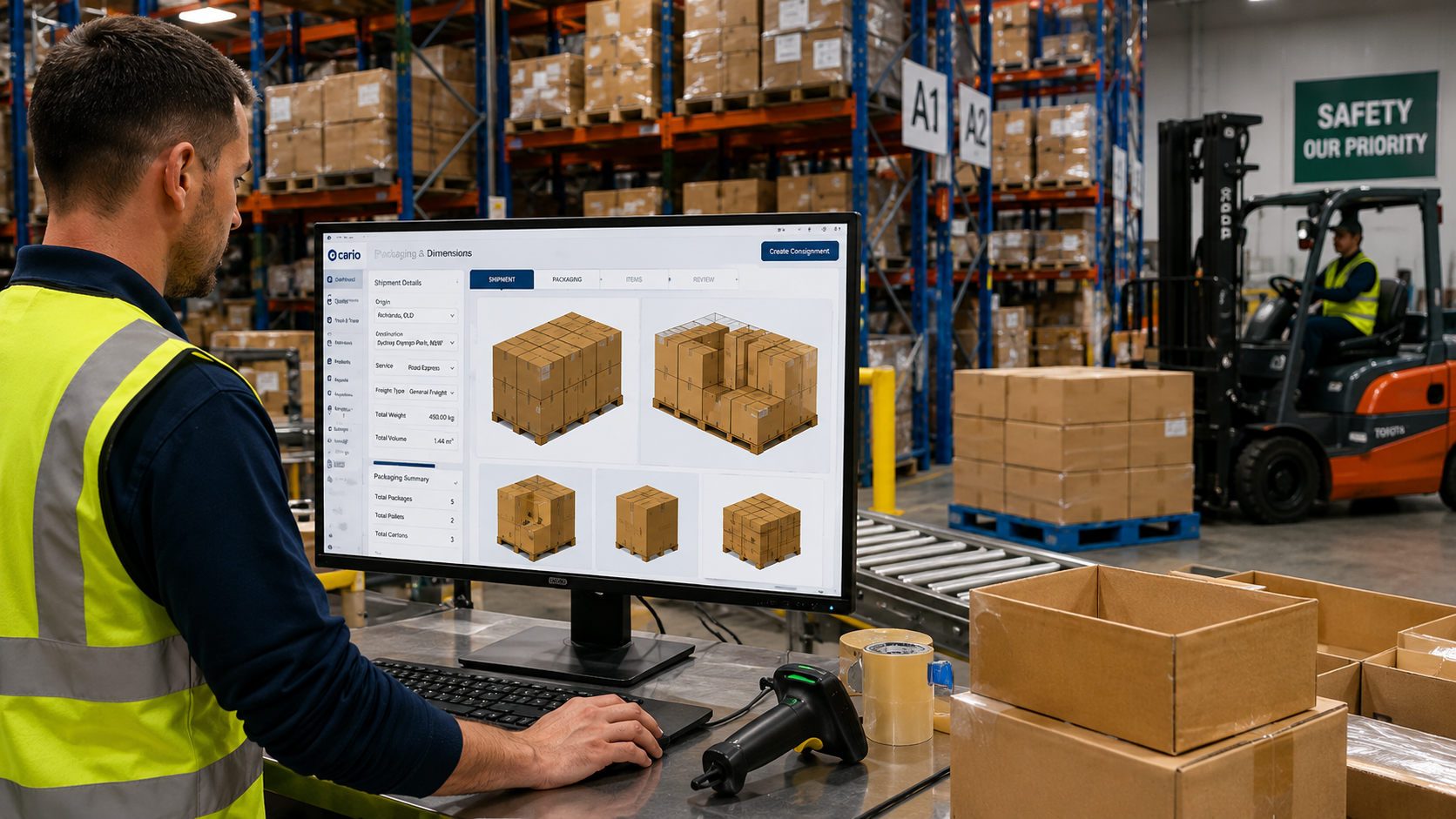
Packing optimisation takes that manual decision-making and replaces it with a consistent, system-driven approach. In Cario, this includes a visual representation of how items are packed, so warehouse teams can see exactly what’s going into each container before the shipment is created
If your warehouse is packing orders manually, there’s a good chance you’re paying more for freight than you need to.
It’s not usually obvious. Everything leaves the warehouse. Orders get delivered. But behind the scenes, small inefficiencies in how items are packed can add up quickly—extra pallets, wasted carton space, and inaccurate shipment data.
For Australian businesses managing multi-carrier freight, those issues flow straight into higher costs, rework, and avoidable friction across teams.
Packing optimisation fixes that at the source.
Why Packing Decisions Matter More Than Most Teams Realise
In a typical warehouse, packing decisions happen fast.
A picker or packer looks at the order and decides:
What carton to use
Whether it goes on a pallet
How items should be arranged
It’s practical. It keeps things moving. But it also introduces variability.
One person might fit everything into two cartons. Another might use three. Multiply that across hundreds or thousands of orders a day, and the cost impact becomes real.
We’ve seen operations where:
The same order is packed differently depending on the shift
Pallets are underutilised, leaving unused space
Shipment dimensions don’t reflect what was actually sent
Freight charges don’t match expectations
It’s not a people problem. It’s a system problem.
Where the Cost Creep Comes From
Freight costs don’t just come from carrier rates. They come from how efficiently you use space.
Poor packing leads to:
1. More Shipments Than Necessary
Extra cartons or pallets mean more consignments, more labels, and more charges.
2. Wasted Space
Carriers price based on size and weight. If you’re sending air, you’re paying for it.
3. Incorrect Shipment Data
If dimensions and weights aren’t accurate, you’ll see invoice discrepancies later.
4. Rework in the Warehouse
When something doesn’t fit or needs repacking, it slows everything down.
5. Flow-On Issues Across Teams
Customer service deals with delivery issues. Finance deals with invoice mismatches. Operations deals with inefficiency.
It all starts with how the order was packed.
What Packing Optimisation Actually Does
Packing optimisation takes that manual decision-making and replaces it with a consistent, system-driven approach.
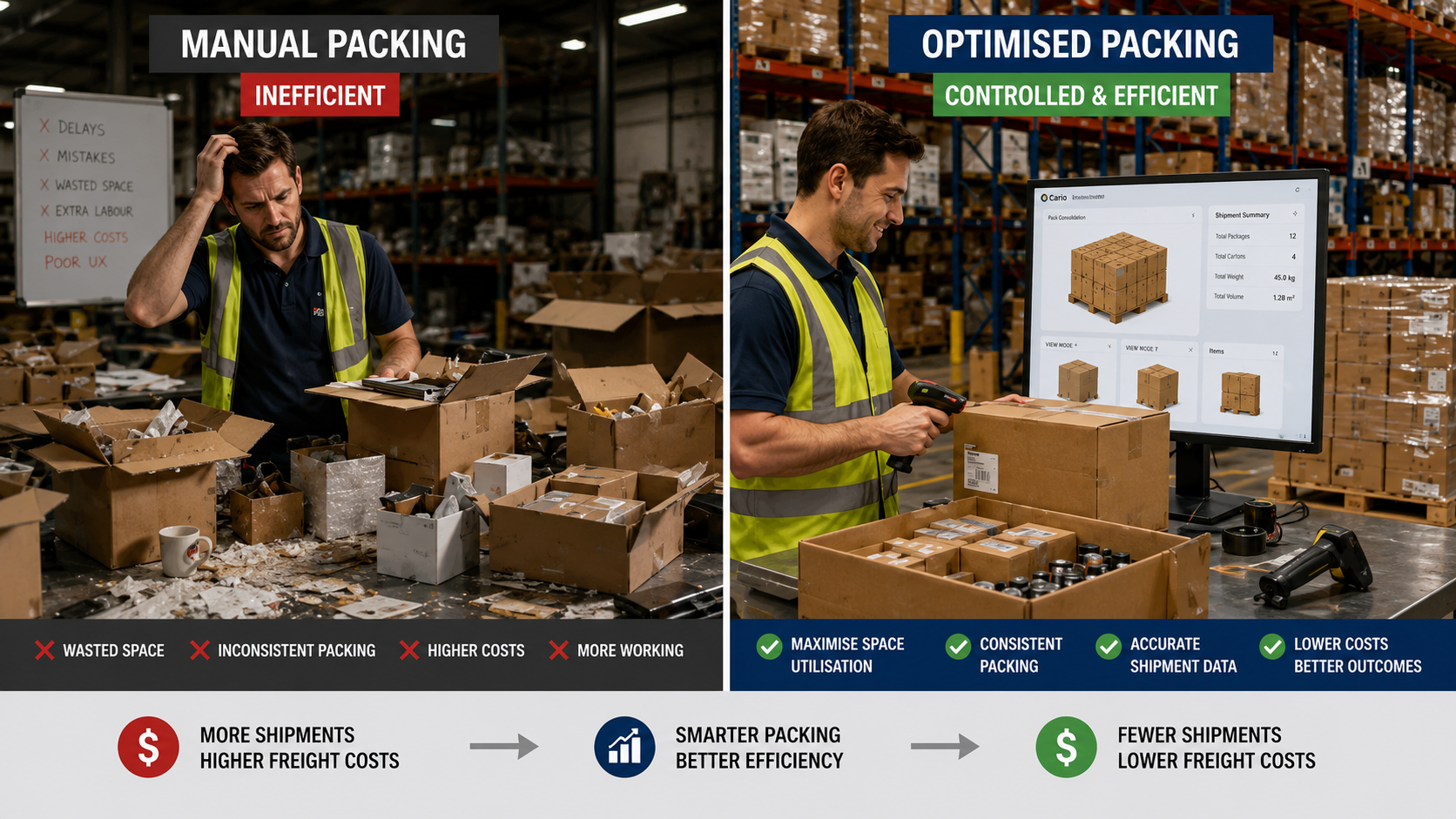
Instead of relying on judgement in the moment, the system:
Looks at product dimensions and weights
Identifies suitable cartons or pallets
Calculates the most efficient way to group items
Outputs a structured packing plan
In Cario, this includes a visual representation of how items are packed, so warehouse teams can see exactly what’s going into each container before the shipment is created
That visual step matters. It gives confidence that what’s planned is actually practical on the floor.
A Simple Example
Let’s say you’re shipping a mixed order:
12 small cartons
4 medium items
2 bulky items
Manual packing might result in:
3 pallets
2 half-empty cartons
An optimised approach might:
Consolidate into 2 full pallets
Eliminate unnecessary cartons
That difference affects:
Freight cost
Handling time
Carrier selection
Delivery efficiency
It’s not dramatic on one order. But across thousands, it adds up fast.
Why This Matters in Australian Freight
Australia adds another layer of complexity.
You’re often dealing with:
Long-distance freight (Sydney to Perth, Brisbane to regional WA)
A mix of metro and regional deliveries
Multiple carriers with different pricing models
Pallet, parcel, and bulky freight in the same operation
That means packing efficiency directly impacts:
Linehaul costs
Carrier choice
Delivery timelines
Overall freight spend
When you’re managing 10, 20, or even 50+ carriers, consistency becomes critical.
The Flow-On Benefits Across the Business
Packing optimisation doesn’t just help the warehouse.
It improves how freight flows across the entire operation.
Warehouse
Faster packing decisions
Less rework
More consistent output
Logistics
More accurate shipment data
Better carrier alignment
Fewer booking issues
Customer Service
Fewer delivery problems
More reliable shipment information
Finance
Better alignment between booked and invoiced freight
Fewer disputes with carriers
Improved cost visibility
It’s one of those changes that quietly improves multiple parts of the business at once.
From Packing to Consignment — Without Rework
One of the biggest advantages is what happens next.
Once packing is optimised:
Shipment structure is already defined
Dimensions and weights are already calculated
Containers are already assigned
That flows directly into consignment creation.
No re-keying. No second guessing.
Just a cleaner, faster path from warehouse to carrier.
When It Becomes Worth It
Packing optimisation becomes especially valuable when:
Order volumes increase
Product ranges expand
Freight types become more varied
New warehouses or sites are added
Costs start creeping up without a clear reason
If your team is starting to feel the pressure, this is usually one of the first areas worth fixing.
A More Practical Way to Improve Freight Efficiency
A lot of freight cost strategies focus on carrier rates.
That’s important. But it’s only part of the picture.
How you prepare shipments before they even reach a carrier has just as much impact.
Packing optimisation gives you:
More control at the warehouse level
Better data flowing into freight decisions
Fewer downstream issues
It’s a practical improvement. Not a theoretical one.
Where Cario Fits
Cario brings this into a broader freight and transport workflow.
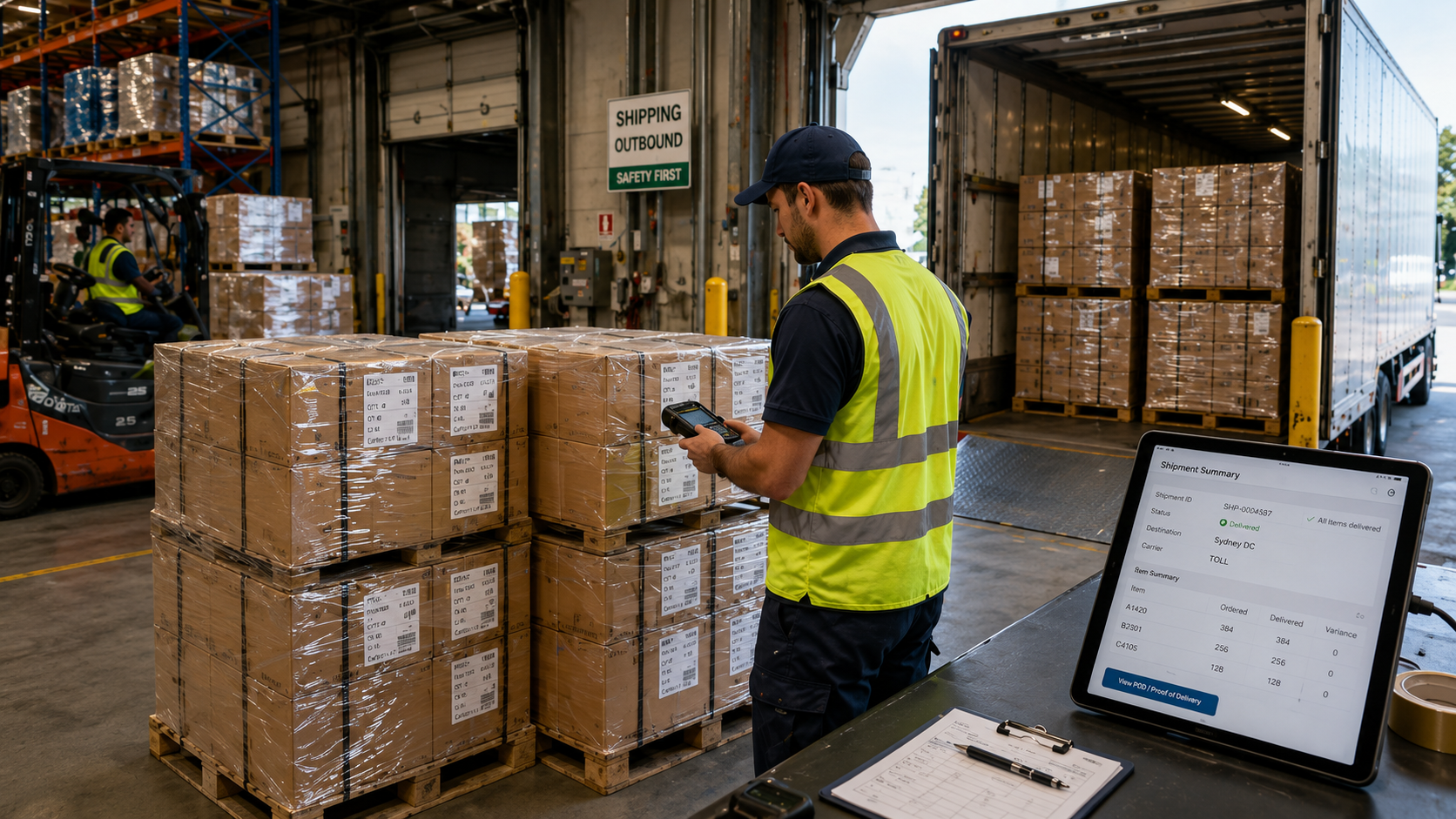
Instead of treating packing as a separate step, it connects it directly to:
Order creation
Shipment structure
Multi-carrier booking
Freight visibility
So your team isn’t just packing better—they’re feeding cleaner, more consistent data into the entire freight process.
Final Thought
Most warehouses don’t set out to pack inefficiently. It happens gradually as volume grows and complexity increases.
Fixing it doesn’t require more training or stricter processes.
It requires better tools.
Packing optimisation is one of the simplest ways to reduce freight waste, improve accuracy, and make your operation easier to run day to day.