

Stop Guessing Freight Costs Before You Book | Cario
30 July 2026

Compare freight cost, ETA and service suitability before booking. See how Cario helps Australian teams make clearer freight quote decisions.
Freight decisions often happen fast.

Freight quotes should help teams make decisions, not just produce a price
It’s a Tuesday in the warehouse, and your customer wants to know when an order will arrive. Meanwhile, the warehouse needs freight off the floor before carrier cut-off. Through all of that, sales is trying to work out whether a delivery can be sent without blowing out margin.
So, someone in the team opens a carrier portal.
Then another.
They see a rate, and an ETA. The warehouse is asked for dimensions. Someone remembers the delivery may need a tail lift. Nobody is quite sure whether hand unload has been allowed for.
By the time the consignment is booked, the original quote may no longer reflect the actual freight task at all.
It is a familiar problem in Australian freight operations. The booking can look perfectly reasonable at the start, then the real-world details arrive later: the pallet is larger than expected, the destination is regional, the site has no forklift, or the carrier that looked cheapest cannot provide the service required.
That is when a simple quote becomes an invoice query, a delivery delay, or a phone call nobody wanted to make.
Therefore, you need a solution that’s designed to give your team a clearer view of their freight options before they commit to a booking.
A quote is only as useful as the information behind it
Freight pricing on the surface covers origin, destination, weights/dimensions, and a number on the screen. It’s more than that though.
Dimensions, weight, packaging type, and all the less glamorous details… tail lift, hand unload, dangerous goods, delivery access, carrier coverage, and the difference between a metro postcode and a regional one that happens to share the same state.
Miss one of those, and the cheapest quote can stop being cheap very quickly.
A carton entered in millimetres rather than centimetres can distort the volume. A missing handling requirement can rule out the selected service. A carrier rate may look attractive until the shipment falls outside its service rules or attracts an additional charge later.
For an operations team under pressure to move freight, this is the difficult balance: book quickly, but do not create a problem for finance, customer service or the customer at the other end.
The right freight decision is rarely just “which option costs the least?”
See cost, speed and service suitability together
Cario’s Quick Quote capability helps teams assess the practical choices available before a consignment is created.
Users can enter the shipment details. Collection and delivery locations, dimensions, weight, quantity, packaging type and relevant handling requirements. Then they can easily view the available carrier services at their disposal for that job.
From there, the decision becomes a lot more useful.
This means your teams can identify the lowest-cost option, the fastest estimated delivery option, and the services that are suitable for the actual freight requirement. It also means a standard replenishment order can go on the most economical suitable service, while a customer-critical delivery can be assessed differently.
Now, sometimes the cheapest carrier is exactly the right choice. There is nothing really clever about spending more where the service requirement does not justify it.
But sometimes the extra cost is buying something real: a faster delivery window, a service better suited to the freight, or more confidence that the booking will meet the customer’s expectation. Your warehouse makes the call on this all the time, even if its by intuition or experience alone.
The quote should give people enough context to make that call properly.
Catch the small details before they become expensive ones
There is an old proverb: for want of a nail, the shoe was lost; for want of a shoe, the horse was lost; for want of a horse, the rider was lost.
The wording has changed over time, but the idea has lasted for centuries because it is true: small omissions can create disproportionately large consequences.
Freight works much the same way, as the problems don’t begin with a dramatic failure. They’ll begin with a detail that was missed while everyone was moving quickly.
Think of the warehouse team who will be dispatching cartons, pallets and bulky freight. Orders are coming in, and carrier cut-off is approaching. Someone needs an answer now.
That is not the moment to rely on old rate assumptions, a spreadsheet from six months ago, or a quick estimate of how much space a shipment will take up.
The great thing about Cario’s Quick Quote option is it can flag shipment information that appears unusual or may affect the booking outcome. Visual indicators help users identify details worth checking before proceeding, including dimensions, volume and other fields that could change the quote or carrier options.
This is practical control, not process for process’ sake.
Catching an incorrect dimension before booking is easier than disputing an adjustment after delivery. Confirming a tail lift requirement upfront is better than discovering the receiving site cannot unload the freight. Making sure the quote reflects the actual job reduces the chance of rework later.
Finance benefits too. Better freight information at the point of booking means fewer surprises when the carrier invoice arrives.
Quote first. Book without starting again.
Quoting should not create another admin task.
Once a team has reviewed the available options and is ready to proceed, the Quick Quote can flow into the consignment process. Key location and item details carry through, so users are not re-entering the same freight task from scratch.
They can then add the full delivery address, references and instructions needed to complete the booking.
Now, it is a small thing, however high-volume operations are built out of small things.
Less retyping means fewer opportunities for errors. Fewer manual checks mean a quicker path from “what are our options?” to “this freight is booked.” And better continuity between the quote and the final consignment means the booking is more likely to reflect what was actually agreed.
Where Quick Quote makes the difference

Quick Quote is particularly useful for businesses managing several carrier choices every day.
Operations managers can make faster decisions without relying on guesswork or carrier portal hopping. Logistics teams can compare cost, delivery timing and service suitability in one place. Warehouse teams can identify freight details that need attention before they create a booking issue.
Customer service has clearer information when a customer asks when an order can be delivered. Sales can make a more informed call about the cost of servicing an order. Finance gets earlier visibility of the likely freight cost, rather than waiting for discrepancies to surface after the fact.
This matters most for Australian businesses dealing with mixed freight profiles, metro and regional delivery networks, multiple carriers, varied handling requirements or high daily consignment volumes.
That is the environment Cario is built for: bringing carrier connectivity, freight decisions, booking, tracking, reporting and cost control into one connected freight operation.
Better freight decisions start before the booking
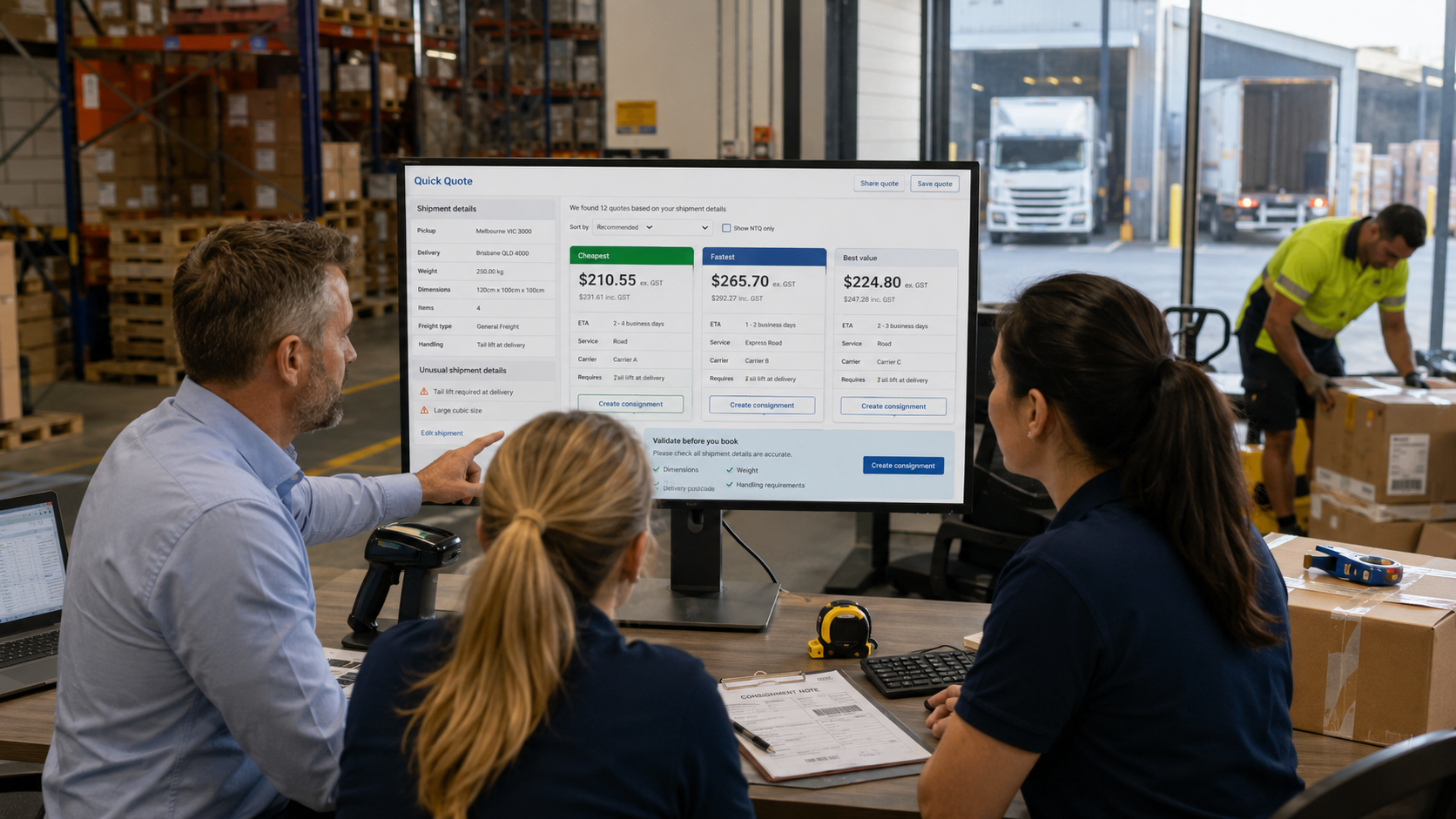
A freight quote should do more than return a number.
It should help a team understand the options in front of them: what the freight will cost, how quickly it may arrive, whether the service fits the job, and whether there are details likely to cause trouble later.
Cario Quick Quote gives teams that earlier view.
It helps turn freight quoting from a hurried pricing exercise into a more informed booking decision - one that considers cost, service and delivery requirements together.
When freight is business-critical, guessing is expensive.
A clearer quote process helps your team choose the right service before the consignment is created.
See the full picture before you book
Cario brings carrier cost, service options and delivery confidence into one booking decision - so your team can choose the option that makes sense for each delivery, not simply the one with the lowest number beside it.