

Why ERP and Freight Don’t Align (And How to Fix It)
03 August 2026

Struggling with mismatched freight data between your ERP and warehouse? Learn why shipments break down and how to fix the gap for smoother operations.
Why Freight Breaks Between Your ERP and Warehouse
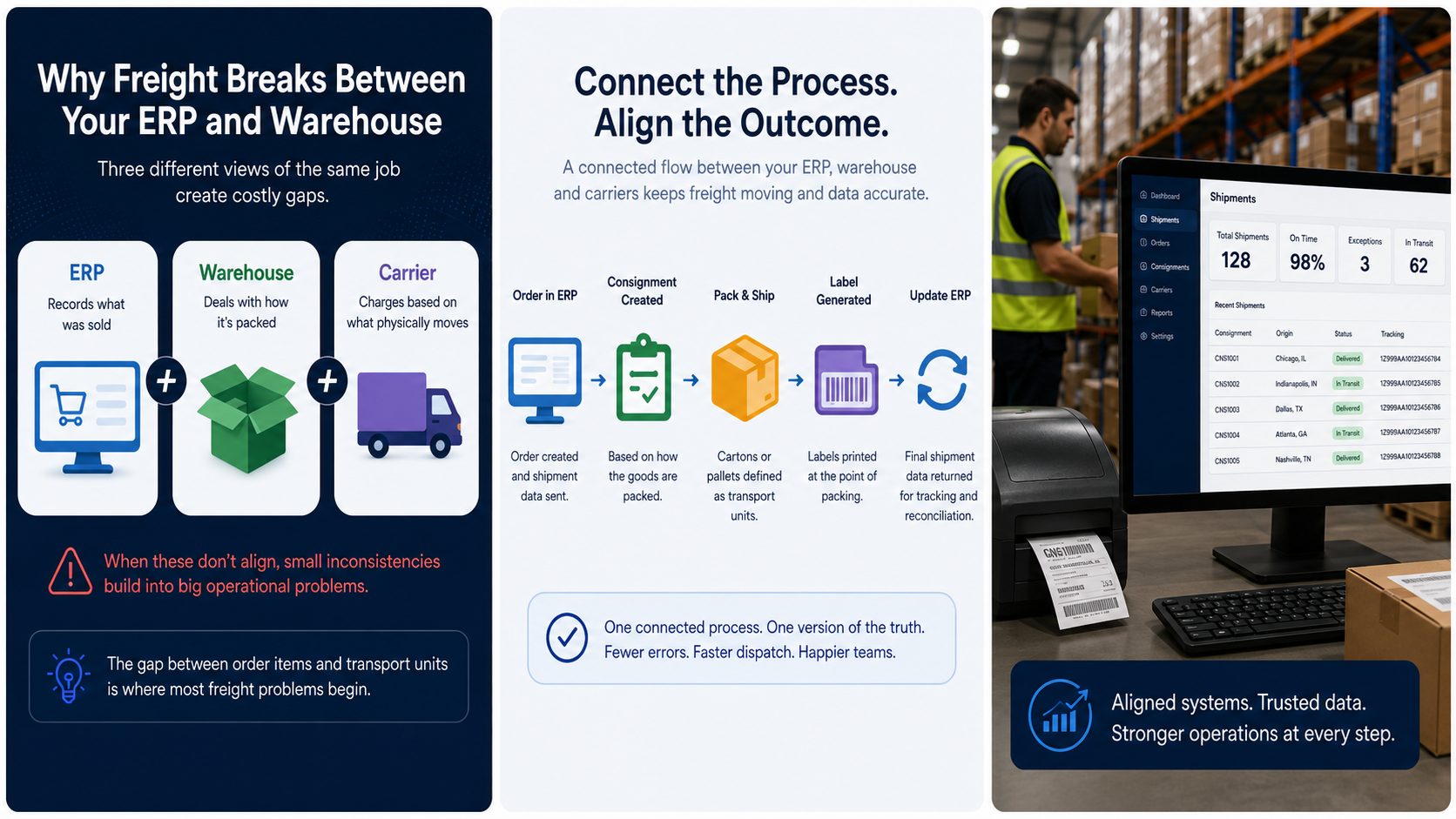
Most operational issues don’t start on the warehouse floor. They start earlier, in the handover between systems.
Your ERP creates the order. The warehouse picks and packs it. The carrier moves it. On paper, that sounds straightforward. In practice, those three steps are rarely aligned.
The problem sits in how each part of the process defines the shipment.
Your ERP records what was sold. Your warehouse deals with how it’s packed. Your carrier charges based on what physically moves. Those are three different views of the same job—and if they aren’t connected properly, small inconsistencies start to build.
The internal note makes this distinction clear. Order items represent the products sold, while transport units represent what actually leaves the warehouse.
That gap is where most freight problems begin.
Where It Starts to Break Down
You’ll see it in subtle ways at first. A label doesn’t quite match what’s packed. A shipment gets split differently to what the ERP expected. Customer service asks a simple delivery question, and the answer requires checking multiple systems.
No single issue looks serious. But over time, the pattern becomes obvious.
Warehouse teams start adjusting details on the fly just to get consignments out the door. Labels are generated outside the ERP because it’s quicker. Different teams rely on their own version of the truth. When finance reviews freight costs later, they’re working backwards to understand what actually happened.
The operation keeps moving, but it relies on experience and workarounds rather than clean data.
Why This Becomes an Operations Problem
At lower volumes, teams can manage around these gaps. Someone knows how to fix things. Someone double-checks the details. Someone takes ownership when something looks off.
As volume increases, that safety net disappears.
More carriers introduce more variation in how freight is handled. Pallets and bulk freight add another layer of complexity. Multiple warehouses create inconsistency in how shipments are prepared and recorded. What used to be a manageable workaround turns into constant rework.
Operations teams feel it first. Dispatch slows down, errors become harder to trace, and simple tasks start taking longer than they should. The issue isn’t effort. It’s structure.
The Shift That Fixes It
The fix is not pushing your ERP to handle freight better. Most ERPs aren’t designed for that level of physical execution.

The shift is separating and then properly connecting the key pieces of the process.
Orders remain where they belong—in the ERP as a record of the commercial transaction. Shipments are handled as consignments. The physical freight is defined clearly as cartons, pallets or other transport units.
Once those elements are structured properly, they can be connected in a way that reflects how freight actually moves.
This is where Cario fits. It sits between your ERP, warehouse and carriers, acting as the layer where freight execution happens. It brings those moving parts into one process, while still integrating back into your core systems.
What Changes in Practice
In a connected setup, the flow becomes consistent.
An order is created in the ERP, and the relevant shipment data moves into the freight layer. A consignment is created based on how the goods are packed, not just what was sold. Cartons or pallets are defined clearly as the units being shipped. Labels are generated at the point of packing, and the final shipment details are returned to the ERP for tracking and reconciliation.
The internal note outlines this pattern, including real-time consignment creation and label generation tied directly to warehouse activity.
There’s no need to re-enter data or correct it after the fact. The process reflects what is actually happening on the floor.
What This Means for Operations
For an operations manager, the impact is less about new capability and more about removing friction.
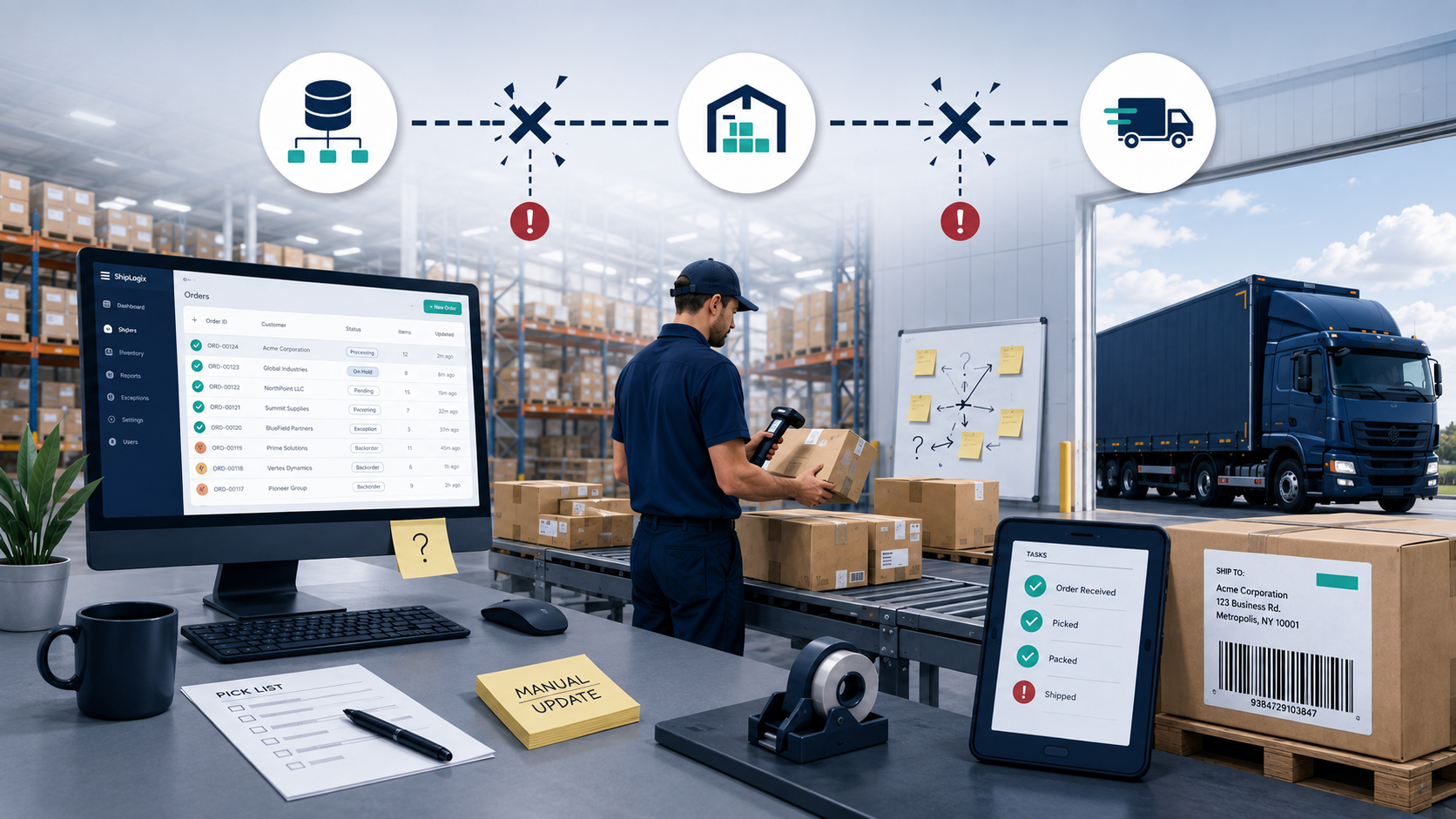
Dispatch becomes more predictable because the system matches how the warehouse works. Errors reduce because the physical shipment and the system record are aligned from the start. Teams stop spending time fixing issues after dispatch, and instead focus on moving freight efficiently.
Just as importantly, the handover between teams improves. Customer service is no longer chasing the warehouse for answers. Finance is not trying to reconcile mismatched data. Everyone is working from the same version of the shipment.
Scaling becomes more manageable because growth no longer creates the same level of manual effort.
A Simple Way to Tell If This Is Your Issue
Most operations teams don’t describe this as an “ERP integration problem.” They describe it in everyday terms.
They say things like, “We’ll fix it after dispatch,” or “Let me check with the warehouse,” or “That’s not what we shipped.”
Those phrases are a sign that the system and the physical process are out of sync.
What Good Looks Like
When orders, consignments and physical shipments are aligned, the operation feels different.
Dispatch flows without constant intervention. Shipment data can be trusted. Teams spend less time chasing information and more time moving freight. Problems still happen, but they are easier to identify and resolve because the underlying data is consistent.
That’s the difference between an operation that relies on experience to hold things together, and one that is set up to scale.